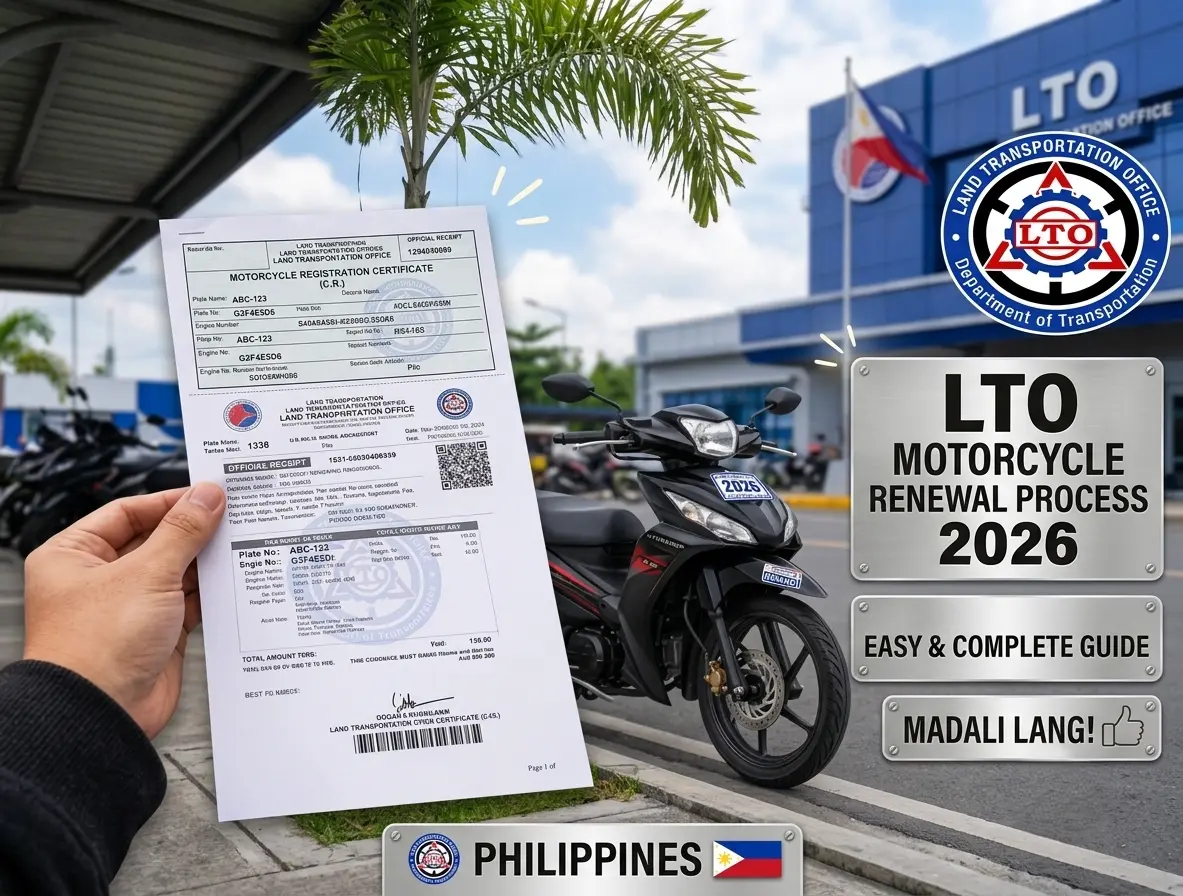
LTO Motorcycle Registration Renewal 2026 – Complete Guide (Requirements, Fees, LTMS Portal)
Riding a motorcycle in the Philippines comes with one yearly duty: registration renewal. Many riders put it off. They think it takes too long, or they forget the deadline. But an expired registration can cost you far more than the renewal fee itself. It can mean fines, a suspended license, or even an impounded motorcycle.
This guide covers everything you need for LTO motorcycle registration renewal in 2026. You will learn the requirements, the exact fees, how to use the LTMS portal, and what happens if you renew late. By the end, you will know exactly what to do and when to do it.
What Is LTO Motorcycle Registration Renewal?
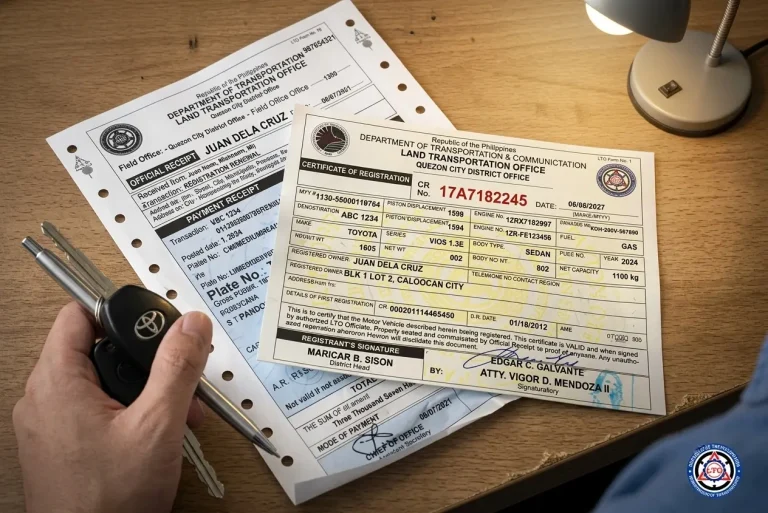
LTO portal motorcycle registration renewal is the yearly process of updating your motorcycle’s official record with the Land Transportation Office. When you first bought your motorcycle, the LTO gave you two documents: the Certificate of Registration (CR) and the Official Receipt (OR). These prove that your motorcycle is legally yours and safe to drive.
Over time, that registration expires. Renewal simply refreshes it. The LTO checks that your motorcycle still passes emission standards, that it has valid insurance, and that it is safe to use on public roads. Once everything checks out, you get an updated OR and CR with a new expiry date.
Think of it like renewing a passport. Your motorcycle does not change, but the government paperwork that proves it is roadworthy and legally registered gets refreshed.
Motorcycle registration renewal matters for more than just following the law. An updated CR is proof of ownership. You need it if you plan to sell, transfer, or use your motorcycle as collateral for a loan. Without a valid registration, none of these transactions are possible.
Motorcycle Registration Validity: 1 Year, 3 Years, or 5 Years?
Not every motorcycle renews every year. In 2026, the validity period depends on when and how your motorcycle was first registered.
Under the current rules, brand-new motorcycles with an engine size of 200cc and above now qualify for a five-year initial registration validity, but only when the dealer handles the registration at the time of purchase. This is a major shift from the old system, where most motorcycles needed renewal every single year.
Motorcycles below 200cc, or those registered outside the dealer program, typically get a three-year initial validity before switching to the standard annual renewal cycle.
Here is a simple breakdown:
This means you should not assume you need to renew every year just because that used to be the rule. Always check the expiry date printed on your OR/CR. If you are unsure, you can confirm your exact validity period through your LTMS account or by asking your dealer.
Once your motorcycle moves past its initial validity window, it enters the standard yearly renewal cycle explained in the next section.
Why Renewal Matters: What Happens If You Don’t Renew
Skipping your motorcycle registration renewal is a costly decision. The Land Transportation Office enforces real penalties, and they add up fast.
Here is what you risk by riding with an expired registration:
Renewing on time usually takes less than two hours of your day. Letting it lapse can cost you thousands of pesos and days of hassle. The math is simple: renew early, and stay worry-free.
When to Renew: LTO Schedule by Plate Number
The LTO does not let everyone renew at the same time. Instead, it spreads renewals across the entire year using a plate number system. This prevents long lines and overcrowded branches.
Your renewal schedule depends on two numbers from your plate:
Here is how the month assignment works:
| Last Digit of Plate | Renewal Month |
| 1 | January |
| 2 | February |
| 3 | March |
| 4 | April |
| 5 | May |
| 6 | June |
| 7 | July |
| 8 | August |
| 9 | September |
| 0 | October |
And here is how the week assignment works, based on the second-to-last digit:
| Second-to-Last Digit | Renewal Week |
| 1, 2, or 3 | Week 1 |
| 4, 5, or 6 | Week 2 |
| 7 or 8 | Week 3 |
| 9 or 0 | Week 4 |
Example: If your plate ends in “68,” the last digit (8) means your renewal month is August. The second-to-last digit (6) falls in the 4-5-6 range, so you renew during the second week of August.
Can you renew early? Yes. You can renew up to 60 days before your assigned month, which is a smart move if you want to skip the queue and avoid any risk of missing your deadline. If you are traveling abroad during your renewal period, some LTO portal branches allow renewal up to a year in advance with proof of travel.
It is also worth noting that in 2026, the LTO issued a temporary validity extension for licenses and registrations expiring in April, May, and June, pushing the deadline to the end of July without penalties. Extensions like this can change from year to year, so it always pays to double-check your specific status on the LTMS portal before assuming a deadline has moved.
LTO Motorcycle Registration Renewal Requirements (Checklist)
Before heading to the LTO or logging into the portal, gather these documents. Missing even one item can mean a wasted trip.
Core requirements for a plain renewal:
Special cases that need extra documents:
If your CTPL, emissions test, and inspection results are already electronically linked to your LTMS account, much of this becomes a formality rather than a paper hunt, since the system pulls the records automatically.
LTO Motorcycle Registration Renewal Fee 2026 (Complete Breakdown)
Renewal costs vary depending on your motorcycle’s engine size, your location, and whether any penalties apply. On average, a plain motorcycle registration renewal in 2026 costs between ₱1,000 and ₱1,800, though it can run higher for larger-displacement motorcycles.
Here is a general breakdown of what makes up that total:
| Fee Component | Estimated Cost |
| Registration/Renewal Fee | ₱659.31 |
| Motor Vehicle cost User’s Charge (MVUC) | ₱240 – ₱300+ (varies by engine size) |
| CTPL Insurance | ₱250 – ₱650 |
| Emission Testing (PETC/PMVIC) | ₱150 – ₱400 |
| Computer/System Fee | ₱67.50 |
| Estimated Total | ₱1,000 – ₱1,800+ |
Electric and hybrid motorcycles get a discount on the MVUC portion under the Electric Vehicle Industry Development Act, so owners of e-bikes typically pay less.
Late renewal penalties:
Rehistro ng Motor Price
Kung gusto mong malaman kung magkano ang bagong rehistro ng motor, karaniwang umaabot ito sa ₱1,000 hanggang ₱1,800, depende sa laki ng makina at sa mga karagdagang bayarin tulad ng CTPL insurance at emission test. Laging tiyakin ang eksaktong halaga sa LTO cashier o sa iyong LTMS account bago magbayad, dahil maaaring magbago ang presyo depende sa rehiyon at klase ng motorsiklo.
How to Renew Motorcycle Registration at LTO (Step-by-Step, In-Person)
If you prefer the traditional route, here is what to expect at an LTO branch:
- Prepare your documents. Bring your OR, CR, valid ID, CTPL insurance, and TIN.
- Get your motorcycle inspected. An LTO inspection aide checks your headlights, brakes, signals, chassis number, and engine stencil.
- Complete the emission test. If you have not already done this at an accredited center, you will need the results before evaluation.
- Go to the evaluation counter. An LTO evaluator reviews all your paperwork. This is where mistakes get caught, so double-check everything beforehand.
- Pay at the cashier. Settle the full renewal fee and keep your receipt safe.
- Wait at the releasing counter. Listen for your name or the name on your CR.
- Collect your new OR. Keep it together with your CR whenever you ride.
Processing time at most branches averages around three hours for in-person renewal. Arriving early in the day, and early in the week, usually means a shorter wait.
How to Renew Motorcycle Registration Online via LTMS Portal
The LTMS (Land Transportation Management System) portal lets eligible motorcycle owners skip the branch entirely. Before you start, make sure your renewal is a plain one, meaning there is no change in ownership, engine, or color, and there are no pending violations tied to your record.
Step-by-step online renewal:
Most online renewals take less than thirty minutes from start to finish, once your documents are in order. If your LTMS renewal gets blocked, it is usually due to an outstanding violation, a mismatch between your CR details and your actual motorcycle, or an insurance record that has not been transmitted yet.
Getting a New LTO Plate Number for Your Motorcycle
Many riders, especially those with recently purchased motorcycles, do not yet have a permanent plate. This is common because plate release from the LTO can be delayed by months.
If your motorcycle does not have a permanent plate yet, here is what you should know:
Keep in mind that under recent LTO regulations, motorcycles are no longer required to display a front plate, so if an officer questions you about a missing front plate, it helps to have a copy of the relevant advisory on hand.
Common Mistakes to Avoid
Small errors cause the most delays. Watch out for these:
- Letting CTPL insurance expire before renewal. Always renew your insurance first, since LTMS validation depends on it.
- Bringing mismatched documents. If your CR lists details that do not match your actual motorcycle, such as engine number or color, your inspection will fail.
- Using unaccredited testing centers. Emission and inspection results from unofficial centers will not transmit to LTMS and will not be accepted.
- Falling for fake LTMS websites. The LTO has issued repeated warnings about phishing sites that imitate the real portal. Only use portal.lto.gov.ph.
- Forgetting to update your registered address. Renewal notices and plate releases go to whatever address is on file. An outdated address means you might miss important updates.
- Waiting until the last week. Long queues and system delays are common near deadlines. Renewing early avoids this entirely.
- Assuming yearly renewal without checking your OR/CR. With the new multi-year validity rules, you might not be due for renewal yet.
LTO vs DMV: Quick Note for International Readers
If you are used to the term “DMV” from the United States, the Philippines does not have a Department of Motor Vehicles. The Land Transportation Office, or LTO, handles all vehicle registration, licensing, and renewal duties instead. Everything in this guide about DMV registration renewal, fees, and the LTMS portal applies specifically to the LTO system in the Philippines.
Frequently Asked Questions
Practical Tips for a Smooth Renewal
A little planning goes a long way at the LTO. Keep these habits in mind:
These small steps can turn a task that usually takes hours into one that takes minutes.
Conclusion
LTO motorcycle registration renewal form does not have to be stressful. Know your validity period, check your plate-based schedule, gather your documents early, and decide whether the LTMS portal or an in-person visit works better for you. A little preparation saves you from penalties, long queues, and unnecessary stress. Renew on time, and enjoy the road knowing your motorcycle is fully legal and ready to ride while following safe driving practices, including knowing when to overtake safely.