When is it Allowed to Overtake on a Curve in the Philippines? (LTO Guide 2026)
Driving in the Philippines is an exciting experience. However, navigating its diverse landscapes requires deep knowledge of road safety rules. Among the many traffic maneuvers, overtaking another vehicle on a two-lane road is one of the most critical. It demands absolute focus and a clear understanding of the law.
The situation becomes even more intense when approaching a curve, bend, or hill. Many drivers wonder: when is it allowed to overtake on a curve? This comprehensive guide breaks down the exact legal conditions, Land Transportation Office (LTO) regulations, and real-world safety procedures to keep you safe and help you pass your LTO exams.
What Does Overtaking Mean?
Before looking at specific highway laws, it is important to define the core action. In simple driving terms, overtaking occurs when a faster vehicle moves past a slower-moving vehicle traveling in the same direction.
Understanding Overtaking Under the Land Transportation and Traffic Code
In the legal framework of Philippine transportation, overtaking is not just a casual driving habit. It is an official maneuver heavily regulated by the state. According to the foundational Land Transportation and Traffic Code, passing another vehicle requires extreme care. The law explicitly states that a driver must ensure the road ahead is entirely clear before pulling out of their lane. The lane change must happen without interfering with the speed or safety of any oncoming traffic or the vehicle being passed.
Why Drivers Overtake Other Vehicles
On real Philippine roads, several practical scenarios prompt a driver to consider overtaking:
Understanding these reasons helps clarify why standard overtaking rules Philippines exist. They balance structural traffic flow with human safety.
What Does Republic Act 4136 Say About Overtaking?
The ultimate legal authority governing all road use, licensing, and traffic management in the country is Republic Act 4136, also known as the Land Transportation and Traffic Code. This law sets the standard for how drivers must behave on national highways, local streets, and expressways.
+—————————————————————————–+
| REPUBLIC ACT NO. 4136 |
| “The Land Transportation and Traffic Code of the Philippines” |
| |
| Section 41. Restrictions on overtaking and passing: |
| (a) The driver of a vehicle shall not drive to the left side of the |
| center line of a highway in overtaking and passing another vehicle |
| proceeding in the same direction unless such left side is clearly |
| visible and is free of oncoming traffic for a sufficient distance… |
+—————————————————————————–+
General Overtaking Rules Under Republic Act 4136
The general driving regulations states that on standard two-lane roads, a passing maneuver must always take place on the left side of the vehicle being overtaken. Pulling into the opposite lane of traffic means you are entering a high-risk zone. RA 4136 specifies that this left lane must be completely visible and free of oncoming traffic for a long enough distance to complete the entire pass without hazard.
Responsibilities of the Overtaking Driver
If you are the driver executing the pass, the burden of safety falls heavily on your shoulders. The rules for overtaking on the road dictate that you must:
Responsibilities of the Vehicle Being Overtaken
Safety is a shared responsibility on the road. RA 4136 outlines specific rules on turning and overtaking that govern the driver being passed. When another vehicle signals its intent to pass you, you are legally required to give way. You must not increase your vehicle’s speed until the passing vehicle has completed its maneuver and returned safely to the lane. If necessary, you should steer slightly toward the right edge of the roadway to grant maximum clearing space.
When Is It Allowed to Overtake on a Curve?
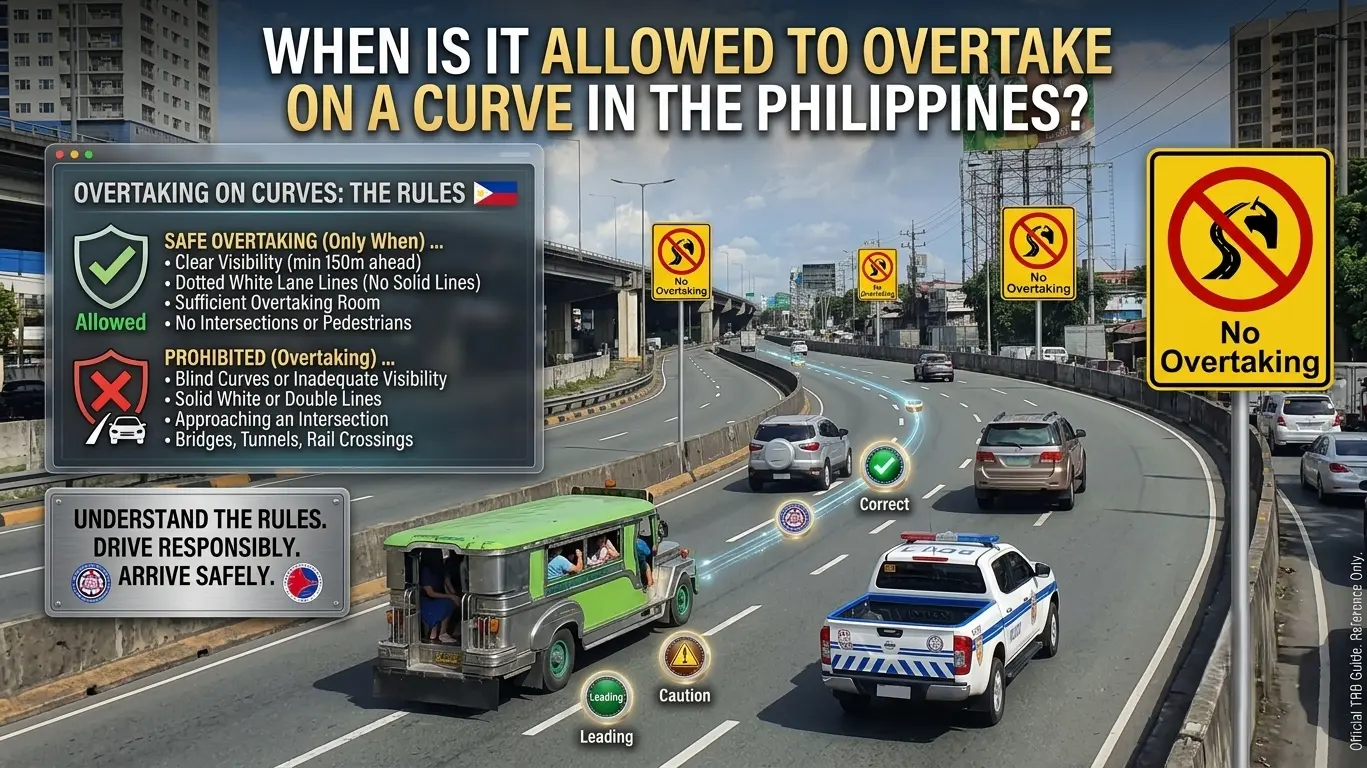
Now, let us tackle the core question directly. Is a driver ever allowed to pass another vehicle along a curved piece of road? The short answer under Philippine law is: No, unless highly specific safety conditions are completely met.
If the Driver’s View Is Not Blocked Within a Distance of 150 Meters
The absolute golden rule for passing on curves in the Philippines centers on visibility distance. Under Republic Act 4136, Section 41, overtaking on a curve is strictly illegal unless the driver’s view is not blocked within a distance of 150 meters (500 feet) ahead.
If you look at the curve ahead and cannot see a full 150 meters of open, unobstructed highway because of the angle, trees, rock formations, or buildings, you are legally forbidden from attempting a pass.Full Visibility and Enough Space to Pass Safely
Even if the 150-meter visibility requirement is physically satisfied, the law demands that you have full visibility and enough space to fully execute the entire maneuver. You must calculate not just what you see right now, but where your vehicle will be at the end of the pass. If the space narrows down the road or the curve sharpens rapidly, you do not have enough legal space to make the move.
Clear Road Signs Permit Overtaking
Your personal judgment must always be backed up by official highway markers. You may only pass if clear road signs or painted highway lines explicitly indicate that passing zones are open. If there is a sign stating “No Overtaking,” that sign completely overrides your personal assessment of the road’s visibility.
When There Is No Oncoming Traffic
It sounds obvious, but it remains a pillar of traffic law: the oncoming lane must be empty of any approaching cars, motorcycles, or large trucks. Because vehicles traveling in the opposite direction along a curve are also dealing with limited visibility, a sudden oncoming vehicle leaves zero escape routes on a narrow, two-lane road.
Overtaking Upon a Curve: When Is It Prohibited?
In the vast majority of real-world driving situations, overtaking upon a curve is highly illegal. The structural hazards of winding roadways make passing a leading cause of severe head-on collisions.
Blind Curves
A blind curve is any bend in the road where the physical geography blocks your view of the road ahead. Whether it is a mountain pass lined with solid rock or a provincial road flanked by thick tropical foliage, blind curves make it impossible to see oncoming traffic. Overtaking here is an automatic major traffic violation.
Approaching a Crest of a Grade
A crest of a grade refers to the top peak of a hill. When you are approaching a crest of a grade, your vehicle’s headlights and your eyes are angled upward toward the sky. You cannot see what is waiting just over the other side of the hill.
Because of this severe blind spot, RA 4136 declares that passing a vehicle is strictly prohibited to overtake on curves with reduced visibility caused by hills, crests, and sharp slopes.
Bends and Hills With Reduced Visibility
Mountainous regions across the Philippines feature combined hazards: a sharp road curve built directly onto a steep hill climb. These complex bends, hills, and valleys reduce visibility down to dangerous levels. Drivers should never pull out to pass when the layout combines vertical hills with horizontal road curves.
Curves Marked With Solid Lines
The Department of Public Works and Highways (DPWH) paints very specific lines on asphalt and concrete roads to guide drivers safely. A solid yellow or solid white line down the center of the road means passing is completely banned. You must never overtake on solid lines, even if the vehicle ahead of you is traveling slowly.
Overtaking Upon a Crest Approaching a Bridge
Bridges are rigid structures with narrow lane margins and no highway shoulders. RA 4136 clarifies that overtaking near the approach to any bridge, or on the bridge deck itself, is illegal. The lanes narrow down, leaving no buffer space if a passing maneuver goes wrong.
Road Signs and Markings Every Driver Must Understand
To drive legally and pass your LTO exam, you must memorize the language of painted pavement markings. These visual indicators tell you exactly when a passing maneuver is permitted or illegal.
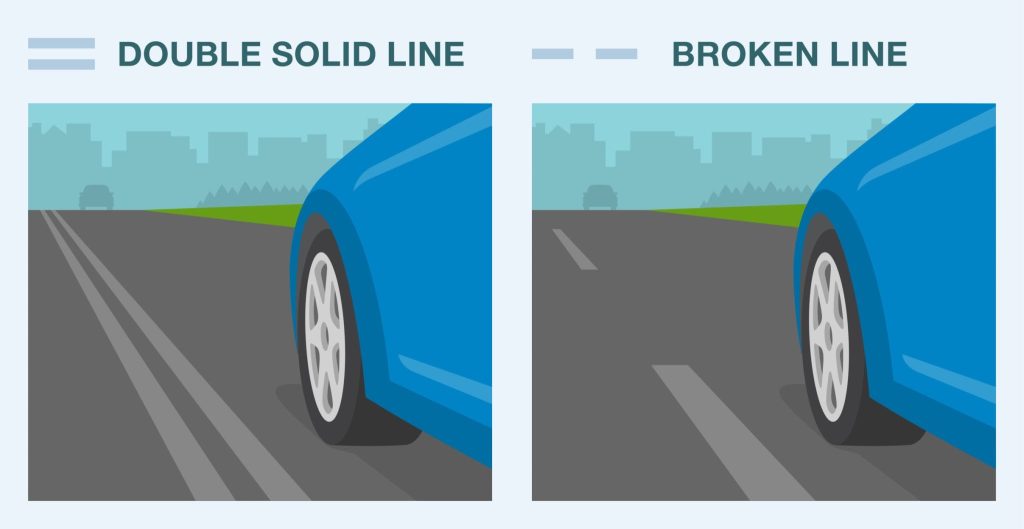
Broken Lines vs Solid Lines
No Overtaking Signs
These are Toll Regulatory Board traffic signs featuring a white circular background with a red border and a black diagonal slash across two cars. Seeing this sign means all overtaking maneuvers are frozen until you pass an “End of No Overtaking Zone” sign.
Warning Signs Before Curves
These diamond-shaped yellow signs feature sharp black arrows curved to the left or right. They warn you that a curve is coming up fast. When you see a curve warning sign, your focus should shift to slowing down and stabilizing your lane position, rather than trying to pass.
Normally on a Two-Lane Road, Overtaking Is Allowed When…
Reviewing standard driving scenarios on flat, open roads helps clarify why curves are treated with such caution by traffic enforcers.
The Opposite Lane Is Clearly Visible
Normally on a two-lane road, overtaking is allowed at the moments when the highway opens up into a long, flat, straight line. Your eyes can scan hundreds of meters ahead, giving you plenty of time to spot incoming cars and calculate your pass safely.
The Maneuver Can Be Completed Safely
A safe pass means you can smoothly signal, move out, pass the vehicle, and return to your lane without forcing any other driver to slam on their brakes or alter their steering path.
Road Markings Allow Passing
As shown in the road markings guide, passing is only valid when the painted lines on the road surface are broken, clear, and visible.
Can a Driver Safely Overtake on the Right in Business or Residential Areas?
While passing on the left is the standard highway rule, drivers often ask about passing on the right side within towns, cities, and residential subdivisions.
Business District Rules
A business district is packed with pedestrian crosswalks, parked delivery vehicles, and turning traffic. Because of these hazards, passing on the right is highly restricted. You cannot simply use the right shoulder or a parking lane to speed past slower cars.
Residential Area Overtaking Rules
In neighborhoods where children, slow moving tricycles, and pets are close to the road surface, speeds are low. Passing maneuvers are discouraged due to the immediate risk of hitting pedestrians stepping off the curb.
Exceptions Allowed by Law
So, when can a driver safely overtake on the right of a vehicle within a business or residential district? Under RA 4136, passing on the right is legal only under these strict exceptions:
Why Overtaking on Curves Is Dangerous
The physics of a turning vehicle combined with limited human sight lines makes passing on a curve an incredibly dangerous gamble.
[BLIND CURVE HAZARD VIEW]
/ / <– Oncoming Vehicle (Hidden)
/ /
/ /
/ / [Hill / Rock Wall / Trees]
/ / Blocks line of sight!
/ /
/ / <– Slower Truck
/ / x <– Overtaking Car (In Wrong Lane!)
/ /
/ /
Reduced Visibility
When you enter a bend, the front hood of your car turns before your eyes can see down the next straight segment of road. This basic lack of visibility means you are driving blind into an oncoming lane whenever you attempt to pass on a curve.
Head-On Collision Risks
Because two vehicles traveling in opposite directions are both moving at speed around a curve, their closing speed is combined. If you pull into the oncoming lane and an oncoming car appears, a devastating head-on collision can happen in a split second.
Speed Misjudgment
It is incredibly difficult to accurately judge the exact speed and distance of an oncoming vehicle when it is traveling along an angled curve. A car that looks far away can close the gap much faster than an overtaking driver expects.
Vehicle Control Problems
When a vehicle enters a curve, centrifugal force naturally pulls it toward the outside edge of the bend. If you try to accelerate rapidly to pass another car while managing a sharp turn, you risk losing tire traction, slipping off the blacktop, or rolling your vehicle.
Safe Overtaking Practices for LTO Exam and Real-World Driving
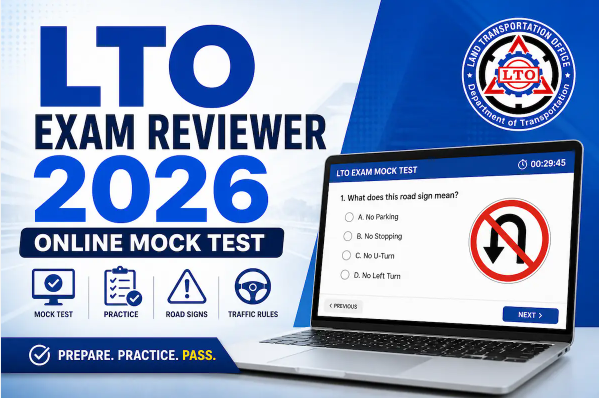
Whether you are studying for your lto exam (such as the comprehensive cde exam for license renewals) or driving out on the highway, following these steps will keep you safe.
Check Mirrors and Blind Spots
Before moving your steering wheel, scan your center rearview mirror and your side wing mirrors. Turn your head quickly to check your shoulder blind spots. This ensures no fast motorcycle or car is already passing you from behind.
Signal Before Passing
Activate your turn signal at least three to five seconds before moving lanes. This clear communication gives the drivers around you plenty of time to adjust their speed and watch your movements.
Maintain a Safe Following Distance
Never tailgate a slow vehicle before passing it. Staying too close cuts off your view of the road ahead and prevents you from accelerating smoothly. Fall back slightly so you can see past the vehicle ahead before launching your pass.
Only Overtake When It’s Legal
Always remember the golden rule taught in driving schools: only overtake when it’s legal and completely safe. If you have any doubts about the visibility distance, the oncoming lane, or the road markings, stay in your lane and wait for a straight stretch of highway.
LTO Violations and Penalties for Illegal Overtaking
The LTO takes illegal passing maneuvers very seriously because they often lead to severe accidents on provincial highways.
Violation Type
Average Monetary Fine
Administrative Action
Illegal Overtaking (RA 4136)
₱1,000 to ₱2,000+
Demerit points added to driver profile
Reckless Driving
₱2,000 (1st Offense) to ₱10,000+
Potential temporary suspension of license
Common Overtaking Violations
Common citations issued by traffic enforcers across the Philippines include passing on solid double lines, passing inside a blind curve, overtaking at a designated intersection, and passing a vehicle on the right side without a legal exception.
Fines and Administrative Penalties
An illegal pass usually results in a standard fine for reckless driving or violating traffic signs. Under modern LTO guidelines, violations add demerit points to your record. Accumulating too many points can make you ineligible for a 10-year driver’s license renewal.
Possible Impact on Your Driver’s License
Your official registration of motor vehicle may be suspended if you are caught using an unregistered vehicle to commit chronic reckless driving offenses. Furthermore, if an illegal pass results in property damage or physical injury, law enforcement can confiscate your driving license on the spot, and the courts can permanently revoke your driving privileges.
Common LTO Exam Questions About Overtaking
Review these official test questions and answers to prepare for your LTO theoretical examinations.
When Is It Allowed to Overtake on a Curve? (LTO Exam Answer)
What Is the Violation of a Driver Overtaking at an Intersection Having a One-Lane Direction?
Overtaking Upon a Crest Approaching a Bridge Is Prohibited Unless?
How Many Meters of Clear Visibility Are Required?
Frequently Asked Questions
Final Thoughts
Overtaking on a curve is one of the most high-risk maneuvers a driver can make in the Philippines. While Republic Act 4136 provides a narrow exception via the 150-meter visibility rule, the safest choice is almost always to wait.
By staying patient, understanding road markings, and waiting for a flat straightaway, you protect your wallet from costly LTO fines and ensure everyone on the road arrives safely at their destination. Keep these principles in mind for your next LTO exam and your daily drives!