The Ultimate LRT-1 Stations Guide 2026: Route Map, Schedule, & Fare Matrix
Traveling around Metro Manila can be a very big challenge for daily commuters and tourists. Traffic on the roads changes every minute and often gets terrible. Because of this heavy street traffic, elevated trains like the LRT-1 remain the fastest way to travel across the capital region. The Light Rail Transit Line 1 acts as the main backbone of the city’s transportation infrastructure, helping millions of riders move quickly without getting stuck on busy streets.
If you are trying to plan your daily route to school, looking for an easy LRT-1 stations map, or checking train schedules for the year 2026, this complete guide has everything you need. We have created a simple, step-by-step directory that lists all the LRT-1 stations in their exact order. This guide will help make your daily commute predictable, easy, and completely stress-free.
Overview of the Manila Light Rail Transit System (Line 1)
The Manila Light Rail Transit System is usually called LRT-1, Line 1, or the Green Line. It is the oldest elevated rail line in Southeast Asia, having started its operations back in the mid-1980s. Since then, it has been the top choice for public transportation because it allows riders to completely skip the traffic on major roads like Taft Avenue and Rizal Avenue.
The train system is owned by the government through the Light Rail Transit Authority (LRTA). However, the private operator of LRT-1 in the Philippines is the Light Rail Manila Corporation (LRMC). Since this private company took over management, they have modernized the system by upgrading station structures, improving ticketing systems, and rolling out cool, air-conditioned fourth-generation trains that make the ride much smoother.
This vital train line passes through four major cities inside Metro Manila, creating an easy connection across:
The LRT-1 system does not work alone. It connects very well with the other train networks in Metro Manila. Passengers can easily hop off LRT-1 and transfer to the LRT Line 2 (Purple Line), the MRT Line 3 (Yellow Line), or the Philippine National Railways (PNR). This interconnected design makes it easy to travel across the entire metropolitan area on a single journey.
LRT-1 Stations List in Order (Northbound to Southbound)
To help you travel without getting lost, here is the complete LRT-1 stations list in order from north to south. You can use this exact sequence to count your stops or plan a return trip.
1. Fernando Poe Jr. Station (Formerly Roosevelt / Muñoz)
Located in Quezon City, this is the current northernmost end of the lrt line 1 stations . Formerly called Roosevelt or Muñoz, it was renamed to honor the famous Filipino actor. Getting off here gives you quick access to Congressional Avenue, FPJ Avenue, and major shopping malls like SM North EDSA and Trinoma via short jeepney rides.
2. Balintawak Station
This station sits near the border of Quezon City and Caloocan City, right next to the North Luzon Expressway (NLEX) entry point. It is a popular stop for shoppers visiting the nearby Landers Superstore Balintawak or the busy Balintawak Cloverleaf wet market.
3. Monumento Station
Monumento is one of the busiest stations in Caloocan City, serving thousands of passengers daily. It is a main central hub for people traveling toward Valenzuela, Malabon, and Navotas. If you are planning a trip from Monumento to MOA (Mall of Asia), this is exactly where your train journey begins.
4. 5th Avenue Station
Located further down Rizal Avenue Extension in Caloocan, the 5th Avenue LRT stations list is surrounded by industrial warehouses, local businesses, and residential communities, making it an essential boarding point for neighborhood workers.
5. R. Papa Station
This is the first station as the train enters the City of Manila. It is positioned near the boundary line, sitting close to the Manila North Cemetery and the busy R. Papa street market.
6. Abad Santos Station (Avenida)
Located along Rizal Avenue (Avenida), this stop is named after Chief Justice Jose Abad Santos. It primarily serves the residential sectors of Tondo and Santa Cruz, offering a quick lrt 1 route map to local public markets.
7. Blumentritt Station
This stop functions as an active transport node. Directly beneath the elevated tracks, commuters can easily transfer to the Blumentritt PNR Station for heavier train lines or explore the massive Blumentritt wet market.
8. Tayuman Station
A highly frequented station in Santa Cruz, Manila, Tayuman is the closest stop to the Department of Health (DOH) national headquarters, SM City San Lazaro, and the Archdiocesan Shrine of Espiritu Santo.
9. Bambang Station
This station sits right in the middle of Manila’s medical supplies district. It is the go-to stop for students and professionals heading to the Metropolitan Medical Center or buying affordable medical gear along Bambang Street.
10. Doroteo Jose Station
Doroteo Jose is a massive transfer hub in Manila. A covered, elevated walkway connects passengers directly to the Recto Station of LRT-2, giving riders access to San Juan, Pasig, and Antipolo. It is also near the Jose Reyes Memorial Medical Center.
11. Carriedo Station
Carriedo is located in the heart of old Manila commerce. This is the optimal station going to Quiapo Church, the Divisoria wholesale market, and Binondo (the world’s oldest Chinatown). You can also walk across the Jones Bridge to enter the historic walled city of Intramuros.
12. Central Terminal Station
Positioned near Arroceros Forest Park, this station is the primary stop for Manila City Hall and nearby government offices. It is widely recognized as the central terminal to Intramuros gateway, especially for college students.
13. United Nations (UN) Avenue Station
This station sits near the scenic Rizal Park (Luneta). It is widely known as the primary station near Kalaw Street and provides direct access to the World Health Organization (WHO) office, the National Museum complex, and the Philippine General Hospital (PGH).
14. Pedro Gil Station
A high-volume station that sits in the middle of Manila’s University Belt area. It caters to thousands of students attending the University of the Philippines Manila, St. Paul University, and shoppers heading to Robinsons Place Manila.
15. Quirino Station
Situated at the intersection of Taft Avenue and Quirino Avenue, this stop serves as an important junction. It is the closest landmark station to the newly renovated Manila Zoo and provides jeepney connections toward the Malate entertainment district.
16. Vito Cruz Station
This stop is heavily populated by the academic community. It is the primary mrt stations list in order for De La Salle University (DLSU), College of Saint Benilde, and St. Scholastica’s College, sitting right next to the Rizal Memorial Sports Complex.
17. Gil Puyat Station (Buendia)
Commonly referred to by commuters as the Buendia station, this Pasay City hub is a massive intermodal terminal. Underneath the station, you will find provincial bus lines heading to Batangas, Laguna, and Quezon province, alongside jeepneys traveling into the Makati Central Business District.
18. Libertad Station
Located along Taft Avenue in Pasay, this station is positioned near the Libertad Market, the Pasay City Public Market, and the Victory Pasay Mall, serving a highly active local trading community.
19. EDSA Station
This is one of the highest-density transfer nodes in the country. Passengers can walk through connecting bridges to access the Taft Avenue Station of the MRT-3 line along EDSA. Commuters regularly check the traffic update edsa lrt 1 northbound stations today to decide whether to take the train. It functions as a gateway for travelers moving from Baclaran to Monumento lrt or heading east toward Makati.
20. Baclaran Station
For decades, Baclaran served as the southern terminus of Line 1. It is world-famous for the Baclaran Church and its massive flea markets. Today, trains continue to run from here to the north and vice versa, linking seamlessly with the newly constructed southern tracks.
LRT-1 Cavite Extension Map & New Stations (Phase 1 Operational)
The transport system of southern Metro Manila changed significantly with the partial opening of the Cavite Extension Project. Now that Phase 1 is fully operational, the LRT-1 is composed of 25 stations total, extending the reach of the rail network into the suburban boundaries of Parañaque.
If you look closely at the modern Cavite Extension map, you will see that Phase 1 adds 5 brand-new, modern stations to the line. If you are asking what are the stations of the LRT-1 map extension, here is the official lrt 1 station list currently servicing riders:
[Baclaran] ➔ [Redemptorist-Aseana] ➔ [MIA Road] ➔ [Asia World-PITX] ➔ [Ninoy Aquino] ➔ [Dr. Santos]
21. Redemptorist-Aseana Station
Located just south of the old Baclaran terminus, this station serves the rapidly expanding Aseana Business City and provides an alternative drop-off point for visitors going to the Baclaran Church area.
22. MIA Road Station
This stop is situated near the Manila International Airport Road intersection. It offers a closer transit point for workers and travelers heading toward the various terminal buildings of the Ninoy Aquino International Airport (NAIA).
23. Asia World-PITX Station
This station provides a vital answer to a common question: Is LRT-1 connected to PITX? Yes, it is. The Asia World-PITX hub links passengers directly to the Parañaque Integrated Terminal Exchange (PITX). If you are going to PITX, you no longer need to brave the traffic on surface roads; you can simply step off the train into the country’s most advanced land port.
24. Ninoy Aquino Avenue Station
Positioned along the busy thoroughfare of Ninoy Aquino Avenue, this station provides access to residential compounds, commercial spaces, and local schools inside the Parañaque district.
25. Dr. Santos Station (LRT-1 MetroHub / Sucat)
Serving as the current southernmost operational terminus for Phase 1, the Dr. Santos Station functions as a premier transit hub near Sucat Road. It features a massive intermodal transport terminal (MetroHub) where passengers can easily catch vans, jeepneys, and buses heading deeper into southern communities.
Future LRT-1 Extension Project (Phase 2 & 3)
The growth of the southern rail network does not stop at Parañaque. The construction of Phase 2 and Phase 3 is progressing steadily to bring efficient mass transit directly into the province of Cavite. Once these final phases are complete, the train system will extend its tracks further south, adding three more vital stations: Las Piñas, Zapote, and Niog.
According to the master plan and recent Cavite Extension opening project schedules, these new tracks will allow commuters from southern Luzon to reach the heart of Manila in under an hour. Developers have already laid out the updated Zapote station map, indicating that the terminal will be built near the border of Las Piñas and Bacoor.
When these future sections are fully operational, the system will officially expand from its current 25-station layout to a total of 28 stations, transforming transit for communities in Bacoor and surrounding coastal towns.
LRT-1 Train Schedule & Operating Hours (2026 Updated)
To avoid missing the last train or arriving too early at the platform, keeping a close eye on the updated LRT-1 schedule is highly recommended.
Day Type
First Train (Northbound & Southbound)
Last Train (Northbound From Dr. Santos)
Last Train (Southbound From FPJ Station)
Weekdays (Mon – Fri)
4:30 AM
10:00 PM
10:15 PM
Weekends & Holidays
5:00 AM
9:30 PM
9:45 PM
Weekday vs. Weekend Schedule (Time Open & What Time Close)
On normal business days, stations adjust their lrt 1 operating hours to accommodate early-morning workers. Platforms generally open their gates before the first trip departs at 4:30 AM. Knowing exactly what time open and what time close helps you plan your day efficiently. Be aware that the LRT-1 stations’ time windows shrink slightly on weekends, with trains starting a bit later and closing earlier to allow for system maintenance.
Holiday & Special Schedules (Holy Week 2026 Open Hours)
During major national holidays, the system operates on an adjusted holiday schedule. For instance, during the annual Holy Week 2026 schedule, the rail line traditionally shuts down entirely from Maundy Thursday through Easter Sunday to execute heavy structural repairs and system updates. Always look out for advisory notices regarding closing time today during unexpected weather conditions or severe tropical storms.
LRT-1 Fare Matrix 2026 & Ticket Prices
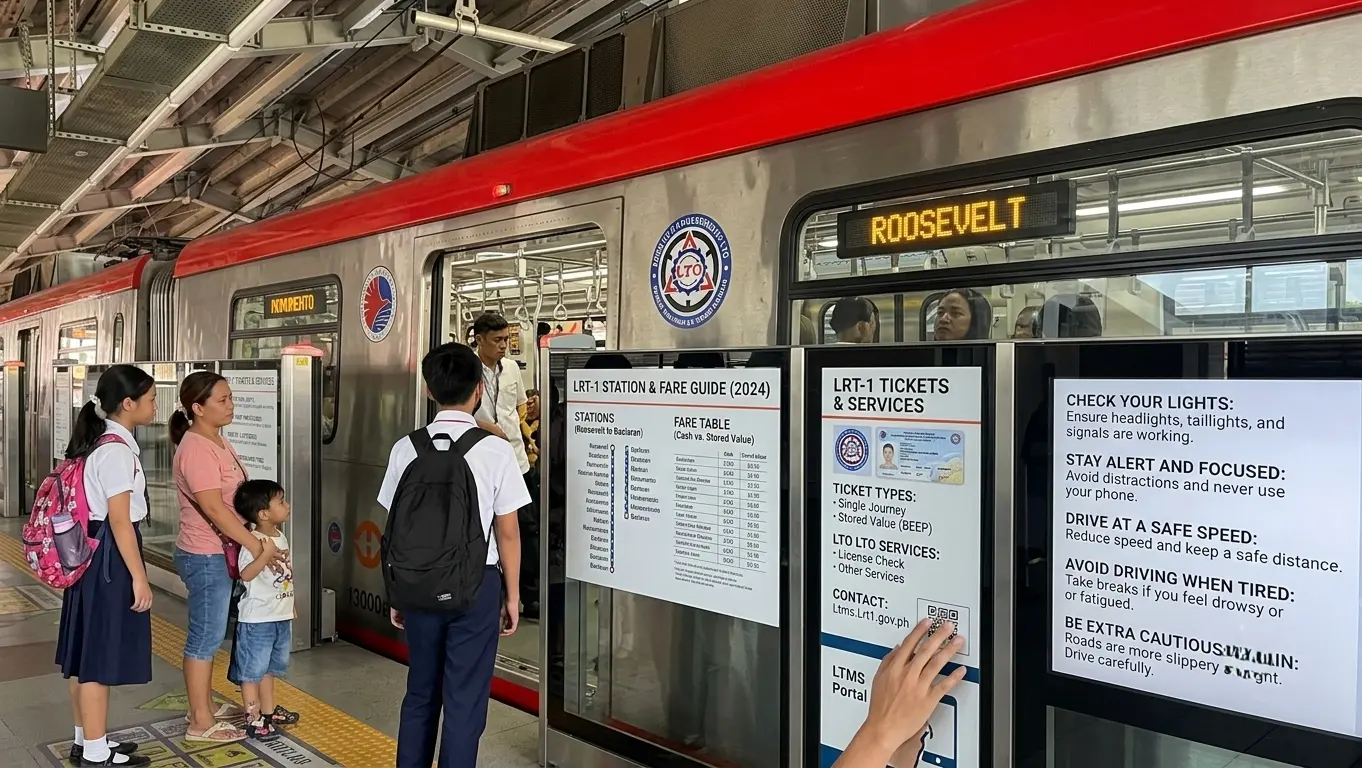
Riding the elevated rail line remains one of the most budget-friendly transport options in Metro Manila. The total cost of your LRT-1 fare depends entirely on the distance traveled between your entry and exit points.
Single Journey Tickets vs. Stored Value Beep Card
When planning your commute, you can choose between two main ticketing options:
Passengers who are eligible for a student fare, senior citizen discount, or persons with disabilities (PWD) privileges receive a 20% discount on all trips. You can easily purchase or reload your lrt 1 stations fare Beep Card at any station teller window, automated ticket vending machine, or through supported mobile banking apps.
LRT-1 Fare Calculator (From Taft / From Baclaran to Monumento)
To budget your weekly travel expenses, you can use the official fare matrix 2026 guidelines. For example, a single trip from Baclaran to Monumento spans across the traditional heart of the city line and will cost approximately ₱30.00 to ₱35.00. Traveling short distances, such as moving from Taft (EDSA Station) to Gil Puyat, stays at the minimum base rate.
Commuter’s Guide: Landmarks & Travel Tips
Using the elevated rail system is the fastest way to visit historical stations near landmarks in Manila and lifestyle spaces across the capital. Here is how you can easily reach Manila’s most famous hubs:
Essential Rules: Dos and Don’ts for LRT-1 Commuters
To ensure a safe, efficient, and comfortable journey for everyone on board, the management enforces strict station guidelines. Review these simple rules before boarding:
The Dos:
The Don’ts:
Video: Virtual Walking Tour of LRT-1 Stations
For visual learners who want to see exactly how to navigate the platforms, transfer walkways, and ticketing counters, watching a first-person perspective video online can be incredibly helpful. You can easily search for a complete virtual tour video of the lrt station near me to see the exact layout of the interchanges so you can travel like a seasoned local.
Frequently Asked Questions (FAQs)
Conclusion
The LRT-1 remains one of the best and most reliable public transportation options in Metro Manila in 2026. With 25 active lrt stations list in order , affordable fares, and ongoing extensions moving into Cavite, it continues to serve millions of commuters every single day. Save this guide for your next trip to travel safely and avoid the heavy road traffic. Safe travels!