Where Can You Contest an Alleged Traffic Violation in the Philippines? (2026 Guide)
Getting a traffic ticket in the Philippines can feel stressful. But here is something many drivers do not know — you have the right to contest it. If you believe the ticket was issued by mistake, or the enforcer did not follow proper procedure, you can legally challenge the violation. This guide will walk you through exactly where to go, what to do, and how to protect your rights.
Quick Overview
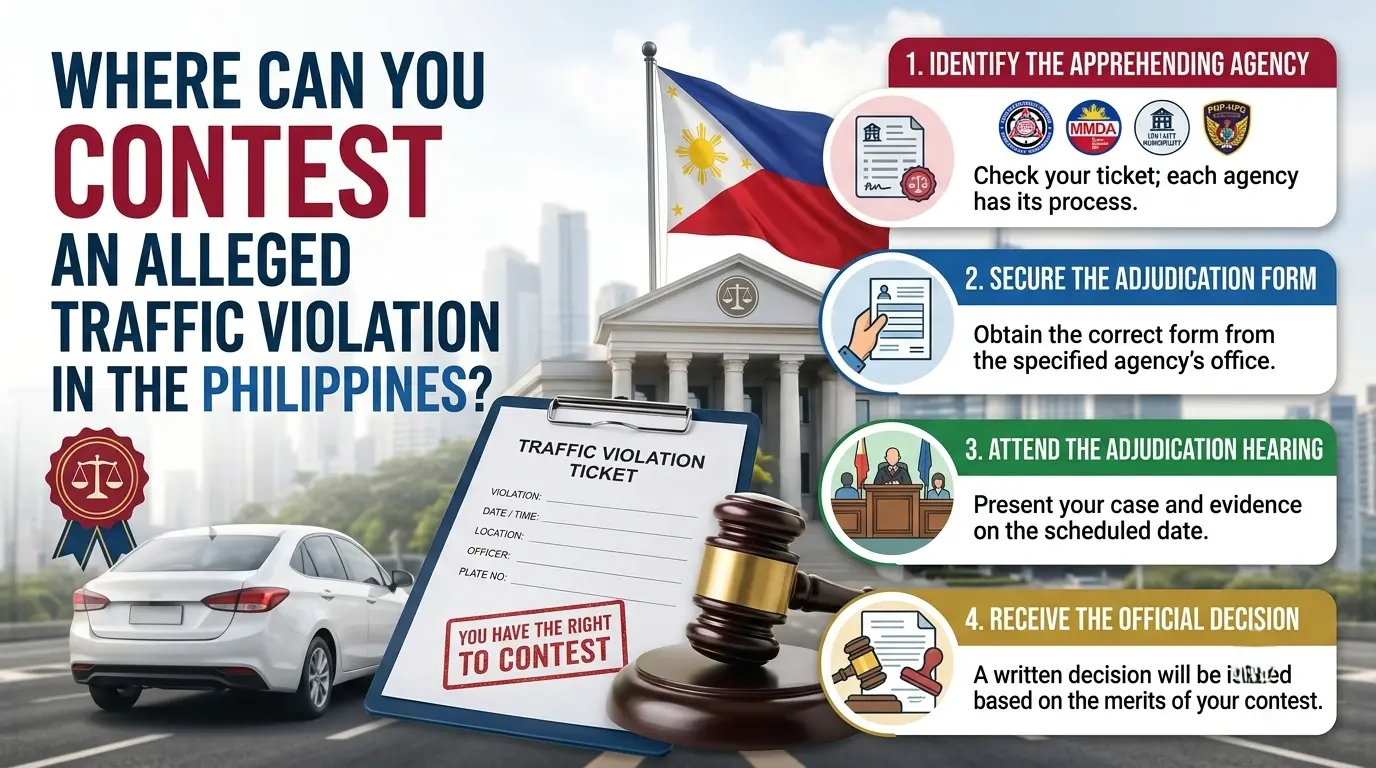
In the Philippines, you can contest an alleged traffic violation at the Traffic Adjudication Office responsible for issuing your ticket. Depending on who gave you the citation, this could be:
Each office handles only the violations under its jurisdiction. Going to the wrong office will waste your time. Always check who signed the ticket first.
What Is an Alleged Traffic Violation?
An alleged traffic violation is a formal accusation that a driver has broken a traffic law. The word ‘alleged’ is important here. It means the violation has been claimed — but not yet proven. You are not automatically guilty just because you received a ticket.
In the Philippines, common traffic violations include beating a red light, illegal parking, overspeeding, no seatbelt, improper lane use, and driving without a valid license. However, enforcers can sometimes make errors. They may cite the wrong driver, enter incorrect details on the ticket, or issue a citation based on a misunderstanding of the law.
This is why the law gives you the right to question or contest the ticket before any penalty is enforced.
Can You Legally Contest a Traffic Ticket?
Yes, you can. Philippine law protects your right to due process. This means you have the right to be heard before any fine or penalty is officially applied to you. You do not have to accept the ticket without question.how to infringement notice
You can contest a traffic violation if:
In some cases, especially for minor violations, you may also explore seeking a plea bargain. This means negotiating with the adjudication office to reduce or modify the penalty rather than fighting the case entirely. However, this is only applicable in specific situations as determined by the adjudicating body.
Where Can You Contest an Alleged Traffic Violation?
The answer depends entirely on who issued the ticket. Each government agency in the Philippines handles its own traffic violations independently. Below is a breakdown of each office and what you need to know.
At the MMDA Adjudication Unit
If your ticket was issued by an MMDA traffic enforcer, you must go to the MMDA Traffic Adjudication Division. This is the office responsible for handling all MMDA-issued citations within Metro Manila.
Where to go: MMDA Traffic Adjudication Division, MMDA Building, Orense Street, Guadalupe Nuevo, Makati City.
Office hours: Monday to Friday, 8:00 AM to 5:00 PM.
What to bring:
You must file your contest within seven (7) days from the date of the violation. Missing this deadline can result in the case being decided without your input.
At the LTO Adjudication Office
If the ticket was issued by an LTO enforcer, your contest should be filed at the nearest LTO district office that covers the area where the apprehension happened.
This is also the office you visit if you are looking for the LTO exam answer on where to contest a traffic violation. The official answer is: at the traffic adjudication office concerned. For LTO-issued violations, that means the LTO district office.
Important: Do not go to just any LTO office. It must be the one with jurisdiction over the area where the ticket was issued. Call ahead to confirm.
For LTO violations, you may also be able to submit a protest letter and request a hearing. Bring all original documents and evidence on the day of your appointment.
At Your LGU or City Traffic Office
Some traffic violations are issued not by MMDA or LTO, but by local government enforcers. These could be city traffic management officers or barangay enforcers working under LGU authority.
If your ticket shows a city or municipality name (for example, Quezon City Traffic Enforcement Unit, Pasig Traffic Management Office, etc.), you must contest it at that specific city’s traffic adjudication office.
Requirements and deadlines vary per LGU. Check your ticket or call the city hall directly to get the correct process for your area.
At the PNP-HPG Office
The PNP Highway Patrol Group (HPG) handles violations on national highways and expressways. If your ticket was issued by an HPG officer, you need to file your contest at the nearest PNP-HPG office.
Common violations handled by HPG: Reckless driving on highways, violations on SLEX, NLEX, TPLEX, and other major expressways, and overloading.
Bring your ticket, a valid ID, vehicle registration, and any evidence you want to present. The HPG follows its own hearing and review procedures, which may differ slightly from MMDA or LTO.
For No-Contact Apprehension Tickets
No-Contact Apprehension Program (NCAP) tickets are issued based on camera footage rather than direct enforcer contact. These are common in cities like Manila, Quezon City, and Valenzuela.
To contest an NCAP ticket, you do not need to visit the traffic adjudication office in person right away. You can:
- Check the violation details online through the official NCAP portal of the issuing city
- Submit a written protest or appeal electronically if the platform allows it
- Visit the physical adjudication office if online options are not available
Because NCAP violations are based on camera images, your strongest defense is showing that the image is unclear, the plate number was misread, or someone else was driving the vehicle at that time.
Step-by-Step Guide to Contesting a Traffic Violation
Follow these steps carefully to give your case the best chance of success.
Step 1 — Check Who Issued the Ticket
Look at your citation ticket and identify the enforcing agency. Is it MMDA, LTO, LGU, or HPG? This tells you exactly which office you need to visit. Going to the wrong office will not stop the case against you.
Step 2 — Read the Violation Details Carefully
Check every detail on the ticket: your name, plate number, vehicle type, date, time, location, and the specific violation cited. Look for any errors or inconsistencies. Even a small mistake — like a wrong plate number — can be a valid ground for dismissal.
Step 3 — Gather Your Evidence
Presenting evidence is one of the most important parts of contesting a traffic violation. Collect everything relevant:
Step 4 — Write a Protest Letter
You will need to submit a written protest explaining why you believe the ticket should be dismissed. Keep your letter clear, factual, and polite. State your name, the ticket number, the date of the violation, and the specific reasons you are contesting it. You will find a ready-to-use sample template in this article below.
Step 5 — File at the Correct Adjudication Office
Visit the correct adjudication office concerned (MMDA, LTO, LGU, or HPG) within the required deadline. Submit your protest letter along with all supporting documents. Make sure to get a receiving copy stamped by the office — this is your proof that the protest was filed on time.
Step 6 — Attend the Hearing or Review
After filing, you will be given a schedule for a hearing or case review. Attend this on time and bring all your original documents and evidence. Be honest, calm, and factual. In some cases, especially for minor violations, the officer may suggest seeking a plea bargain. Consider this option carefully if the evidence against you is strong but the facts of the case have mitigating circumstances.
Step 7 — Wait for the Decision
After the hearing, the adjudication officer will review the case and issue a decision. If your contest is approved, the violation may be dismissed or the penalty reduced. If it is denied, you may have the option to appeal further, depending on the agency’s procedures.
Important Deadlines to Remember
Deadlines vary depending on the issuing agency. Here is a general guide:
| MMDA violations: Contest within 7 days from the date of apprehensionLTO violations: Contact the LTO district office as soon as possible (usually within 5-7 working days) LGU violations: Check your city or municipality’s specific rules NCAP violations: Deadlines are shown on the notice — typically 7 to 15 daysPNP-HPG violations: Contact the nearest HPG office promptly after receiving the ticket |
Missing the deadline almost always results in the case being decided against you automatically. Do not delay.
Do You Need to Pay Before Contesting?
In most cases, no. You are generally not required to pay the fine before filing a contest. Paying the fine is typically treated as an admission of guilt. If you plan to contest the violation, do not pay it first.
However, there are some exceptions. Certain LGU ordinances may require a small filing fee to process your protest. Always ask the adjudication office about their specific rules before paying anything.
If you are unsure, it is safer to ask the office directly: ‘Can I contest this ticket without paying the fine first?’ Get the violation answer key in writing if possible.
Strong Reasons a Violation May Be Dismissed
Adjudicators can dismiss a traffic violation for several valid reasons. Knowing these gives you a better idea of how strong your case is.
1. Wrong information on the ticket: If the plate number, driver name, vehicle type, or location is incorrect, the ticket may be invalid.
2. Lack of evidence from the enforcer: If the enforcer cannot prove the violation actually occurred, the case may be dismissed.
3. Improper apprehension procedure: Enforcers must follow standard procedures. If they violated protocol (for example, they did not show a valid ID when asked), this can be used as grounds.
4. Clear video or photo evidence: If your dashcam or phone footage shows you did not commit the violation, this is powerful evidence.
5. Enforcer was not present or could not be identified: If the enforcer who issued the ticket cannot be verified or does not show up for the hearing, the case may be dropped.
6. Mistaken identity: If someone else was driving your vehicle, proper documentation (affidavit from the actual driver) can support your contest.
Common Mistakes to Avoid
Many drivers lose their contest not because they were guilty, but because they made avoidable mistakes. Here is what not to do:
What If the Enforcer Was Rude or Abusive?
If a traffic enforcer was rude, threatening, or used abusive language or behavior during the apprehension, you have options. Do not engage or escalate the situation at the time — this can make things worse.
What to do instead:
Documenting the enforcer’s behavior can strengthen your case and may lead to separate action being taken against the officer.
What If the Officer Refuses to Show an ID?
Under Philippine law, all public officers — including traffic enforcers — are required to present their official ID upon request. If an enforcer refuses to show their ID, this is a violation of your rights.
Steps to take:
Refusal to show an ID can be a procedural ground that supports your case during adjudication.
Do You Need a Lawyer?
For most traffic violation contests in the Philippines, you do not need a lawyer. The adjudication process is designed to be accessible to regular drivers. If you have clear evidence and a well-written protest letter, you can represent yourself.
However, you may want to connect with a local lawyer if:
Free legal advice is available through the Public Attorney’s Office (PAO). You can also consult platforms like LawInfo or local bar associations to find legal guidance. Getting a second opinion from a professional before your hearing can make a big difference.
Sample Protest Letter Template (Free)
Use this template as your base. Fill in the blanks with your own information. Keep the tone professional and factual.
| Date: [Insert Date] To: The Adjudication Officer[MMDA / LTO / LGU / HPG — choose the correct one][Office Address] Subject: Protest Against Traffic Citation — Ticket No. [Insert Ticket Number] Dear Sir/Madam, I am writing to formally contest the traffic citation issued to me on [Date of Violation] at approximately [Time] along [Location]. The citation was issued by Enforcer [Name/Badge Number], and the stated violation is [Violation Code/Description]. I respectfully contest this citation on the following grounds: 1. [State your first reason — e.g., ‘The plate number on the ticket is incorrect. My vehicle plate is [XXX-000], but the ticket states [YYY-111].’]2. [State your second reason if applicable]3. [State any additional reasons] I am attaching the following supporting documents: – Original citation ticket – Copy of my driver’s license – Copy of OR/CR (vehicle registration) – [Any additional evidence: photos, dashcam footage, etc.] I respectfully request that this case be reviewed and the citation be dismissed based on the grounds stated above. Respectfully yours, [Your Full Name] [Contact Number] [Email Address] [Signature] |
Frequently Asked Questions (FAQs)
Conclusion
Knowing where you can contest an alleged traffic violation in the Philippines is one of the most important things you can do as a driver. You do not have to simply accept every ticket that comes your way. The law gives you the right to question it — and this guide gives you the tools to do so correctly.
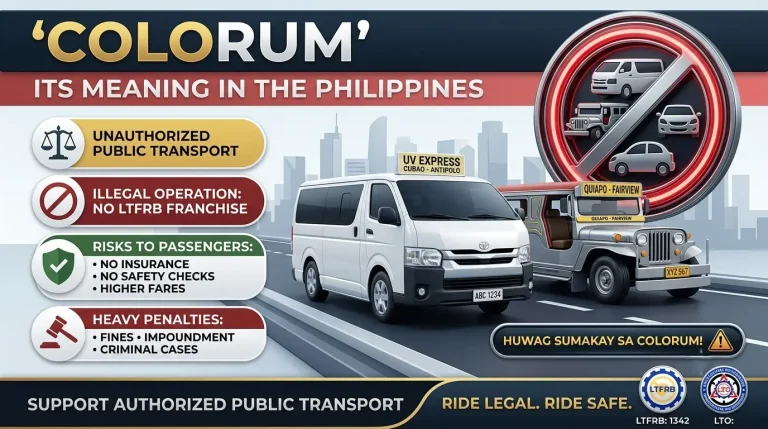
To recap: always go to the traffic adjudication office of the agency that issued your ticket — MMDA, LTO, LGU, or HPG. File your protest within the deadline, bring complete documents, and present your evidence clearly. Stay calm and professional throughout the process, especially if the concern involves a Colorum Vehicle.
If you are unsure about any step, consider reaching out to a local lawyer or contacting the PAO for free legal assistance. Your rights matter — and now you know how to use them.