Where Do You Need to Display Your Plate Number in the Philippines? Complete LTO Guide
Every car, motorcycle, and truck on Philippine roads needs a plate number. It is more than just a piece of metal. Your plate number tells the world that your vehicle is registered and legal to drive. But many drivers still ask: where do you need to display your plate number? And what happens if you get it wrong?
This guide answers that question in simple terms. You will learn the legal rules, the right placement for cars and motorcycles, the truth about plate covers, and the most common violations to avoid.
What Is a Philippine Plate Number?
A Philippine plate number is the unique code given to your vehicle by the Land Transportation Office, or LTO. It works like an ID card for your car or motorcycle. No two vehicles share the same plate number.
Understanding LTO License Plates in the Philippines
The LTO issues every plate number when you register a new vehicle. Each plate carries letters and numbers in a fixed format. For cars, the format is usually three letters followed by four numbers, such as ABC 1234. The first letter tells you which region issued the plate. This system helps police and other drivers identify a vehicle at a glance.
Types of Philippine Plate Numbers
Not all plates look the same. The LTO uses different plate types based on how a vehicle is used:
Each plate type uses its own color scheme, which we will explain later in this article.
What Is the LTO Law About Plate Numbers?
Many drivers ask, “What is the LTO law about plate numbers?” The answer comes from a law that has guided Philippine vehicle registration for decades.
Legal Basis for Displaying Vehicle Registration Plates
The main law is Republic Act No. 4136, also called the Land Transportation and Traffic Code. This law requires every registered motor vehicle to carry an official plate number issued by the LTO. It also gives the LTO the power to set rules on how plates should look and where they should be placed.
For motorcycles, an extra layer of rules comes from Republic Act No. 11235, known as the Motorcycle Crime Prevention Act, or the “Doble Plaka” law. This law was created to make motorcycle plates bigger and easier to read, since motorcycles are harder to track during crimes or accidents.
LTO Rules on Plate Number Display
Under these laws, your plate number must always be:
Failure to follow these rules can lead to a citation and a fine, even if your registration is otherwise valid.
Where Do You Need to Display Your Plate Number in the Philippines?
This is the core question most drivers want answered. The placement rule depends on the type of vehicle you drive.
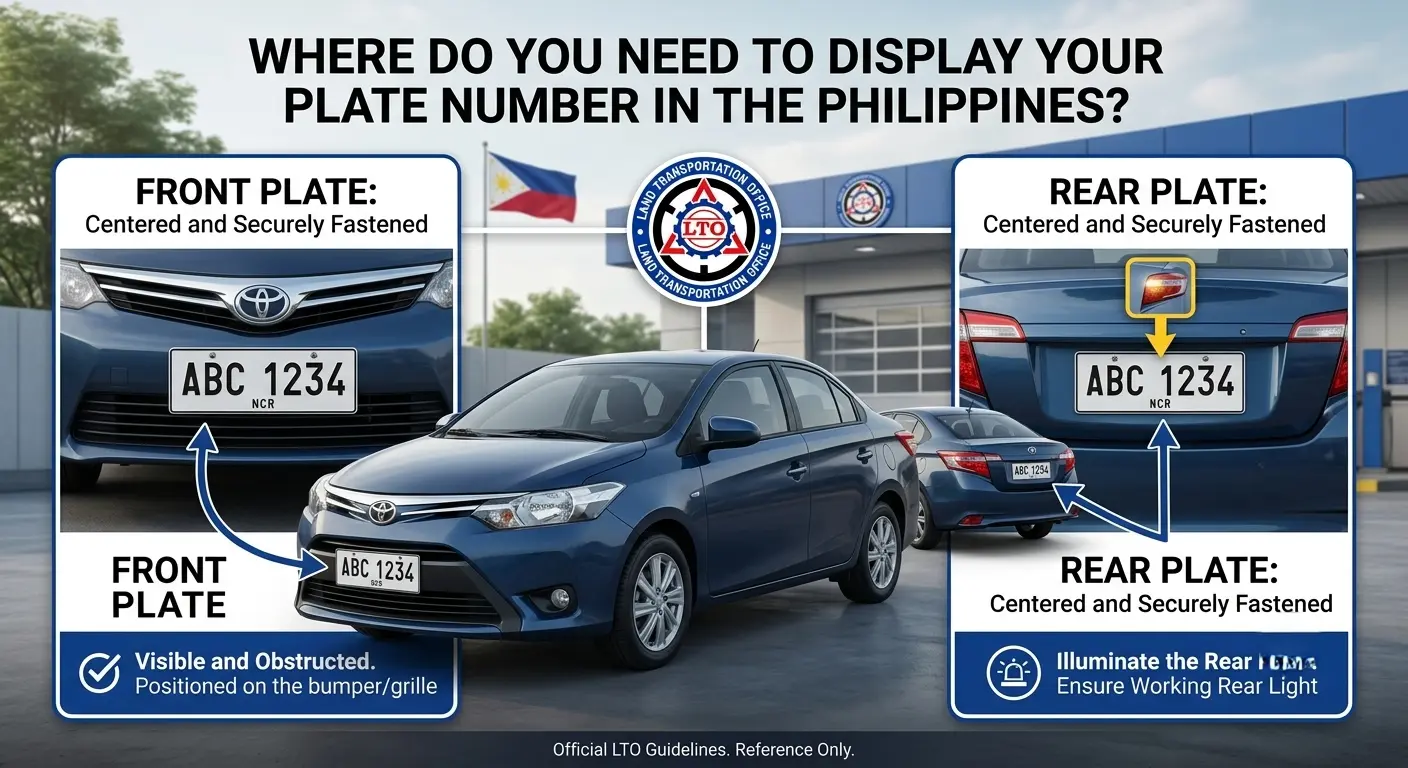
Front License Plate Placement
For cars, SUVs, and trucks, the front plate goes on the bumper or front grille. It should never be placed inside the windshield, since this blocks visibility and breaks LTO rules.
Rear License Plate Placement
The rear plate goes at the center back of the vehicle, just above the rear bumper. At night, the rear plate must be lit so it stays readable in the dark.
Proper Display Requirements for Registration Plates
No matter where the plate sits, it must follow three simple rules: it must be visible from a distance, it must be free of covers that block the view, and it must be mounted straight, not tilted or angled.
Where Should the Number Plate of a Motorcycle Be Displayed?
Motorcycle owners often have more questions than car owners, since motorcycle plate rules have changed several times in recent years.
Motorcycle Plate Number Placement in the Philippines
The rear plate must sit flat and upright at the back of the motorcycle, where it can be seen clearly from behind. Recent updates to the “Doble Plaka” law have shifted the focus to a single, larger rear plate, paired with a front identification decal instead of a second metal plate. This change was made to improve visibility while reducing the safety risks tied to mounting a second metal plate on the front of a bike.
How to Install a Plate Number on a Motorcycle
When installing your motorcycle plate, use the bracket provided by the LTO or an approved aftermarket bracket. Make sure the plate sits flat, not tilted to the side. Avoid blocking the plate with luggage boxes, racks, or stickers.
Is a Plate Holder Allowed by LTO?
Many riders ask, “Is a plate holder allowed by LTO?” A basic plate holder or frame is allowed as long as it does not cover any letters, numbers, or markings on the plate. If a holder hides even part of the plate, it becomes a violation.
LTO Rules on Plate Number Covers (2025/2026 Update)
Plate covers remain one of the most searched topics among drivers, since the rules are often misunderstood.
Are Plate Number Covers Allowed?
Clear, non-tinted covers that do not distort or block the plate are generally tolerated, though many traffic enforcers still discourage their use. Smoked, tinted, or reflective covers are not allowed, since they reduce how easily the plate can be read from a distance.
Plate Number Cover Violations and Penalties
If a cover makes your plate hard to read, you can be flagged for obstruction. This applies even if the cover was meant to “protect” the plate rather than hide it. Penalties vary, but repeated violations can lead to higher fines.
Restricted Plate Accessories and Modifications
Aside from covers, the LTO also restricts other accessories, such as decorative frames with slogans that cover plate numbers, colored films, and any sticker placed directly over the plate’s characters.
Temporary Plates and Vehicle Registration Plates
Brand-new vehicle owners often wait weeks or months before receiving their permanent plate.
Using Temporary Plates While Waiting for Official Plates
While waiting, the LTO allows the use of a temporary plate or printed identifier. This temporary plate must still follow basic display rules: it should be clear, readable, and securely attached, never handwritten or stylized.
Displaying Conduction Stickers Correctly
A conduction sticker, often used for brand-new vehicles, must be placed where it is fully visible, usually on the windshield or another approved spot. Driving without any plate or valid sticker counts as a violation, even if your registration paperwork is complete.
Common Plate Number Violations and Penalties
Understanding common violations helps you avoid unnecessary fines.
Obstructed or Covered License Plates
This happens when dirt, frames, tinted covers, or stickers block part of the plate. It is one of the most common citations given by traffic enforcers.
Unauthorized or Fake Plate Numbers
Using a plate that was not issued by the LTO, or altering the characters on a real plate, is a serious offense. This can lead to vehicle impoundment in addition to fines.
Missing, Lost, or Damaged Plates
If your plate is missing, badly damaged, or unreadable, you must report this to the LTO and request a replacement. Driving without a proper plate, even temporarily, can result in a citation.
Registration of Motor Vehicle May Be Suspended If Rules Are Violated
Repeated or serious violations, such as using a fake plate, can lead to suspension of your vehicle’s registration. This means you cannot legally drive the vehicle until the issue is resolved with the LTO.
How to Read a Car Plate Number in the Philippines
Once you understand the format, reading a plate number becomes simple.
Understanding Philippine Plate Number Formats
Most private vehicles use a three-letter, four-number format, such as ABC 1234. The first letter identifies the region where the vehicle was registered. The remaining letters and numbers are mostly used for identification and do not carry a public meaning.
LTO Plate Number Color Coding Explained
Color coding tells you what type of vehicle you are looking at:
This color system makes it easier for traffic officers and the public to identify a vehicle’s purpose at a glance.
Best Practices for Using and Maintaining Your License Plate
Good habits keep your plate legal and easy to read at all times.
Keep Your Plate Number Visible at All Times
Wash your plate regularly, especially after driving through mud, dust, or rain. A dirty plate can be mistaken for an obstructed one.
Ensure Secure Installation
Use proper bolts or brackets. Loose plates can fall off, get damaged, or become hard to read while the vehicle is moving.
Never Alter or Modify Your Plate Number
Do not bend, repaint, or add designs to your plate. Any change to its original look, even a small one, can be treated as tampering.
Replace Lost or Damaged Plates Immediately
If your plate is lost, stolen, or badly damaged, visit your LTO branch right away to request a replacement. Driving without a valid plate, even for a short trip, puts you at risk of being flagged.
Why Proper Plate Display Matters
Plate display rules are not just paperwork. They serve real, practical purposes.
Legal Compliance
Following plate display rules keeps you compliant with Philippine traffic law and helps you avoid fines, citations, or worse.
Vehicle Identification and Security
A clear, readable plate helps authorities trace stolen vehicles, identify hit-and-run cases, and confirm ownership during disputes.
Road Safety Benefits
When plates are visible, it becomes easier for traffic cameras, enforcers, and other drivers to identify vehicles involved in accidents or violations, which supports faster response and safer roads overall.
How to Verify Your LTO Plate Number Online
If you want to confirm that your plate number is correctly registered, the LTO offers online verification tools through its official portal and the Land Transportation Management System. You will usually need your plate number, engine number, or chassis number on hand. This online check is useful before buying a used vehicle, since it helps confirm that the plate matches the vehicle’s real registration record.
Frequently Asked Questions (FAQs)
Final Thoughts
Knowing where to display your plate number is a small but important part of responsible vehicle ownership in the Philippines. The rules are simple: keep your plate visible, secure, clean, and unaltered, whether you drive a car or ride a motorcycle. Staying compliant not only protects you from fines but also makes the roads safer and easier to manage for everyone.