What Type of Helmet Should a Rider Must Use in the Philippines? (LTO Approved Helmet Guide 2026)
Riding a motorcycle in the Philippines offers a great sense of freedom. It helps you bypass heavy traffic on busy roads like EDSA. However, staying safe on your motorcycle should always be your top priority. Accidents can happen at any time, and your head is the most vulnerable part of your body during a crash.
Because of this, the Philippine government strictly regulates the protective gear that motorcycle riders can wear. To protect yourself and stay compliant with the law, you need to know exactly what the Land Transportation Office (LTO) and the Department of Trade and Industry (DTI) require.
This comprehensive guide will help you understand what type of helmet should a rider must use philippines to keep you safe from road accidents and hefty fines.
Quick Answer – What Type of Helmet Should a Rider Must Use?
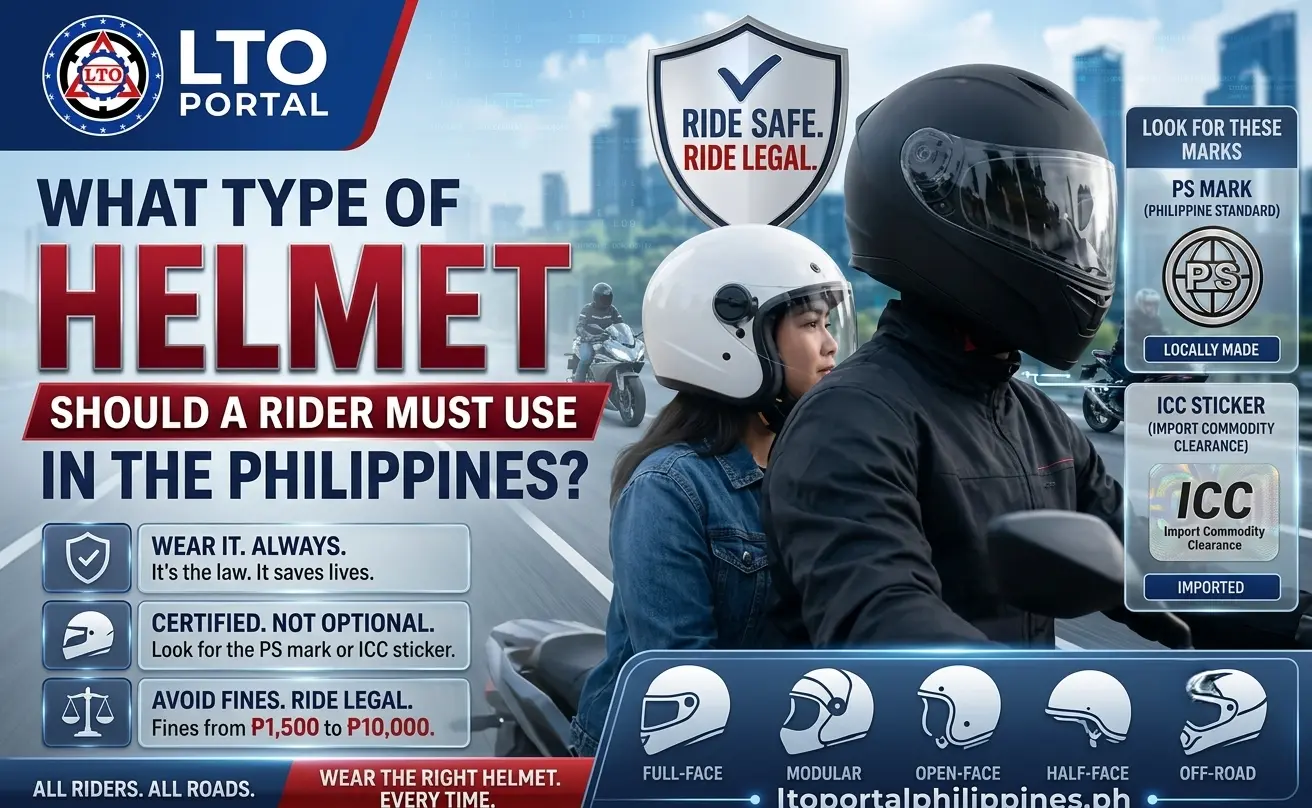
According to LTO rules and Philippine law, what type of helmet should a rider must use is a standard motorcycle helmet that covers the head completely and carries an official Import Commodity Clearance (ICC) sticker or a Philippine Standard (PS) mark.
The direct LTO answer to this common question is that a rider must use either a full-face helmet, a modular helmet, or an open-face (three-quarter) helmet that has been certified by the Department of Trade and Industry (DTI).
Official LTO Answer: A motorcycle rider must wear a standard protective motorcycle helmet compliant to specifications of DTI, featuring a valid ICC or PS mark, with the chin strap securely fastened while driving on any public road or highway.
What Does Philippine Law Say About Motorcycle Helmets?
Motorcycle laws in the Philippines are very clear when it comes to road safety. The state wants to make sure that every motorcyclist has a high level of head protection while traveling, including those working for Transport Network Vehicle Services (TNVS).
Republic Act (RA 10054) – Motorcycle Helmet Act
The foundational law governing helmet use is Republic Act No. 10054, also known as the Motorcycle Helmet Act of 2009. This law mandates that all motorcycle riders must wear standard protective helmets at all times. The main goal of this act is to reduce fatal head injuries during road mishaps. Under RA 10054, the government enforces the manufacturing, importation, and distribution standards of these life-saving gears.
LTO Helmet Rules Every Rider Should Know
The LTO is the primary agency that enforces RA 10054 on public paths. LTO enforcers actively look for riders who violate safety standards. According to their updated guidelines, it is not enough to just place a helmet on your head.
The helmet must be specific to motorcycle use. It must fit properly, and the chin strap must be locked tightly. If your helmet is loose or unfastened, enforcers can pull you over and issue a ticket for a traffic violation.
Is Wearing a Helmet Compulsory for Both Riders and Passengers?
Yes, wearing a standard motorcycle helmet is compulsory for both riders and passengers. The law makes no distinction between the person driving the motorcycle and the person sitting in the back (commonly called the backrider).
Whether you are driving a short distance to the local market or taking a long road trip across provinces in the Philippines, both individuals must wear approved headgear. Even children who are legally allowed to ride as passengers must wear a properly fitting, DTI-compliant helmet.
What Is a Standard Motorcycle Helmet?
A standard motorcycle helmet is a piece of protective gear designed specifically to absorb heavy impacts during a crash. It is built differently from bicycle, industrial, or military helmets.
Standard Motorcycle Helmet Compliant to DTI Specifications
For a helmet to be legally recognized in the Philippines, it must match the strict rules set by the Bureau of Philippine Standards (BPS), which is an agency under the DTI. A standard motorcycle helmet compliant to specifications of DTI must feature a hard outer shell, an inner energy-absorbing liner made of expanded polystyrene (EPS), thick comfort padding, and a strong retention strap system.
+——————————————————-+
| DTI STANDARD HELMET LAYERS |
+——————————————————-+
| 1. Rigid Outer Shell (Absorbs initial impact force) |
| 2. EPS Foam Liner (Cushions & protects the brain) |
| 3. Comfort Padding (Ensures tight, snug head fit) |
| 4. Retention Strap (Keeps helmet locked on head) |
+——————————————————-+
———————————————+ | DTI STANDARD HELMET LAYERS | +——————————————————-+ | 1. Rigid Outer Shell (Absorbs initial impact force) | | 2. EPS Foam Liner (Cushions & protects the brain) | | 3. Comfort Padding (Ensures tight, snug head fit) | | 4. Retention Strap (Keeps helmet locked on head) | +——————————————————-
ICC Sticker Requirement
The most important visual proof of legality on a helmet in the Philippines is the certified sticker. Imported helmets must have a genuine Import Commodity Clearance (ICC) sticker. Local manufacturers must display a Philippine Standard (PS) mark. These stickers are typically placed on the back of the helmet shell or underneath the comfort liner. LTO enforcers look for these specific labels during roadside inspections.
Safety Standards for Riding Helmets
The DTI does not just test helmets randomly; they base their evaluations on global safety metrics. These evaluations ensure the helmet can withstand penetration from sharp objects, resist heavy crushing forces, and stay securely on the head during a violent slide.
International Safety Certifications
Many premium men helmets sold in the market are imported from global brands. The DTI recognizes major international safety certificates. If your helmet features these stamps, it generally qualifies for a DTI clearance:
Features of a Standard Helmet
Every standard helmet approved by DTI or LTO shares key physical traits. It will never feature a brittle plastic outer body. Instead, it uses polycarbonate, fiberglass, or carbon fiber composites. The inner foam layer must be dense enough to slow down the movement of your head during a sudden stop, reducing concussion risks.
Types of Motorcycle Helmets
There are several types of helmet shapes available in local motorcycle shops. Let us break down the design of each helmet style so you can decide which one fits your daily needs.
Full Face Helmet
A full-face helmet offers the maximum amount of protection possible for motorcycle riders. It covers your entire skull, your ears, your cheeks, and your chin. It features a built-in movable visor to protect your eyes from dust, wind, rain, and insects. Because it covers the jawline, it protects your face from severe facial injuries if you slide forward on asphalt.
Modular Helmet
Also known as a flip-up helmet, a modular helmet blends the traits of a full-face and an open-face style. It features a front chin bar hinge mechanism that lets you raise the entire face section upward when you are stopped at a gas station or talking to someone. When you are moving, you click the chin bar back down, and it acts similar to a full-face helmet.
Open Face Helmet
An open-face helmet, often called a three-quarter helmet, covers the top, back, and sides of your head but leaves your face completely open. Many open-face models come with a long clear shield that drops down to cover your eyes and nose. While it provides good cooling airflow for hot summer days in Manila, it leaves your chin unprotected during a head-on collision.
Half Face Helmet
A half-face helmet covers only the top portion of your head down to your eyebrows and the upper back of your skull. It exposes your ears and your entire face. It is lightweight and easy to wear, but it lacks the necessary structural strength needed to protect your head during high-speed impacts.
Half Shell Helmet
Often called a “brain bucket,” a half-shell helmet is a thin, minimalistic dome that sits loosely on top of the head. These are frequently used by cruiser riders or custom vintage bike enthusiasts. They offer very minimal coverage and often fail modern safety impact assessments.
Off-Road Helmet
Designed specifically for dirt biking and motocross tracks, an off-road helmet features an elongated chin piece and a sun peak visor over the top. They do not have built-in eye shields. Instead, they are designed to be worn with large, strap-on dirt riding goggles to keep flying mud out of your eyes.
Adventure (ADV) Helmet
An adventure helmet is a hybrid style that combines the best features of a full-face street helmet and a motocross helmet. It has a large clear face visor, a sun peak brim, and excellent internal ventilation channels. It is optimized for long-distance touring on both paved highways and rocky dirt roads.
Which Helmet Is the Best for Riders?
Choosing the best helmet philippines offers requires looking at safety stats rather than just picking the cheapest option available online.
Full Face vs Half Face
When comparing full-face options against half-face styles, the safety difference is massive. Studies show that roughly 35% of all motorcycle helmet impacts during a crash happen on the chin and jaw area. A half-face model offers zero protection for this zone. Choosing a full-face layout ensures your entire face is insulated from hard impacts.
Which Helmet Is Safe?
Any helmet that protects your brain from injury is safe. Look for a shell that does not bend or crack when compressed by hand. A safe model must have thick internal EPS foam that does not easily deform when you press your finger against it.
Helmet for Daily Riding
For daily commuting in tropical weather, the best choice is an LTO-approved modular or well-ventilated full-face model. These designs shield your eyes from debris on congested roads while providing the impact protection required to keep you safe on public highways.
Is an Open Face or Half Face Helmet Allowed by LTO?
There is often confusion among Filipino riders regarding which exact shapes are legal on public city roads.
Is Open Face Helmet Allowed by LTO?
Yes, is open face helmet allowed by LTO is a yes. Open-face (three-quarter) helmets are legal to use in the Philippines, provided they carry an authentic ICC or PS sticker. The LTO allows these because they still cover the sides and the back of your head properly. They are a popular choice for scooter riders and daily commuters.
Is Half Face Helmet Allowed?
Technically, most traditional half-face or half-shell helmets are not allowed by the LTO on main highways because they do not pass the strict DTI penetration and coverage tests. If a half-face helmet does not have an approved DTI sticker, wearing it will result in a standard fine for riding with a non-compliant helmet.
Is a Tactical Helmet Allowed by LTO?
No, is a tactical helmet allowed by LTO is strictly a no. Tactical helmets, military helmets, and industrial construction hard hats which is not allowed under RA 10054. Even though tactical gear looks rugged and durable, it is built to protect against flying fragments or falling tools—not high-speed vehicular pavement slides. They do not possess the necessary inner EPS liners to cushion your brain during a bike crash, and they do not have DTI approval marks.
How to Check If Your Helmet Is LTO Approved
Before buying any new headgear, you must perform a thorough visual verification to avoid purchasing a counterfeit item.
ICC Sticker
A genuine ICC sticker has a metallic, reflective surface that shines when held under direct light. It contains a unique serial number printed clearly at the bottom. You can verify this number through the DTI website or official tracking mobile applications to confirm its authenticity.
Certification Labels
Look for premium embroidered labels sewn onto the main chin strap of the helmet. High-quality products will feature clear print labels stating compliance with ECE 22.06 or DOT standards alongside their local BPS tracking information.
Original vs Fake Helmet
Fake helmets have flooded online marketplaces. You can identify a fake or substandard helmet by these common warning signs:
How to Choose the Right Motorcycle Helmet
Finding the right gear requires balancing multiple physical parameters to get a safe, comfortable fit.
Correct Helmet Size
To find your correct size, wrap a flexible measuring tape around your head just above your eyebrows and ears. Compare your measurement in centimeters against the specific size chart provided by the manufacturer.
Proper Fit
A new helmet should feel snug around your head and cheeks. It should not cause painful pressure points on your forehead, but it should not shake or roll around freely when you nod your head side to side. Over time, the inner pads will break in and conform perfectly to your facial structure.
Helmet Weight
A heavy helmet can strain your neck muscles during long rides. Try to find an option that weighs between 1.3 to 1.6 kilograms. Carbon fiber or advanced fiberglass materials offer the lightest weight while maintaining excellent structural strength.
Ventilation
Good ventilation is essential in the Philippines due to high humidity and heat. Look for a model that features active brow vents, a chin vent to prevent fogging, and rear exhaust ports to pull warm air out of the shell.
Visor
Your visor should provide a wide, distortion-free view of the road ahead. Clear visors are best for night driving. If you prefer a tinted or smoke visor for bright daytime conditions, make sure it is easy to swap out or choose a helmet with a dual-visor system.
Comfort
The inner lining fabric should feel soft against your skin and feature moisture-wicking properties to manage sweat. Removable, washable inner liners are highly recommended so you can keep your gear smelling fresh.
Best Helmet Brands in the Philippines
Investing in an established helmet brand ensures you get verified protection on the road.
Trusted Helmet Brands
There are several reputable brands available in the Philippine market that are fully approved by the LTO and DTI:
What to Avoid
Avoid unbranded helmets sold by unauthorized sidewalk vendors or sketchy online storefronts. Saving a few hundred pesos on an unverified helmet could cost you your life during an unexpected road accident.
Common Helmet Mistakes Riders Should Avoid
To maximize your safety while driving your motorcycle, avoid these common errors:
Helmet Care, Cleaning, and Storage Tips
Taking care of your protective gear ensures it lasts longer and functions correctly when needed:
When Should You Replace Your Helmet?
Helmets do not last forever. You must replace your motorcycle helmet under the following conditions:
LTO Helmet Violations, Fines, and Penalties
Failing to follow the rules of RA 10054 can result in heavy financial penalties and issues when renewing your driver’s license.
No Helmet Violation
If you are caught driving a motorcycle without wearing a standard protective helmet, the fines under standard LTO rules are structured as follows:
| Offense | Penalty Fee |
| First Offense | ₱1,500 Fine |
| Second Offense | ₱3,000 Fine |
| Third Offense | ₱5,000 Fine |
| Fourth / Subsequent Offenses | ₱10,000 Fine & Confiscation of Driver’s License |
Using a Non-Standard Helmet
Riding with a helmet that lacks a valid ICC or PS mark, or wearing a banned helmet style (like a bicycle dome or tactical gear), carries the exact same financial fines as the no helmet violation.
Passenger Without Helmet
If you are wearing an approved helmet but your passenger is not, you will still receive an LTO traffic ticket. The driver is held legally responsible for ensuring the safety of their passenger while operating the motor vehicle.
LTO Enforcement
LTO officers and deputized local traffic enforcers (like MMDA officers) have the legal authority to check your helmet labels during standard checkpoints. Always stay cooperative and ensure your gear is fully compliant before heading out.
Why Wearing the Right Helmet Saves Lives
At the end of the day, a motorcycle helmet is your most crucial piece of safety equipment. According to global road safety statistics, wearing an approved standard motorcycle helmet reduces the risk of traumatic brain injury by over 65% and drops the risk of death during a crash by nearly 40%.
Your head deserves the best protection possible. By choosing an LTO-approved, DTI-compliant full-face or modular helmet, you protect yourself, obey the laws of the Philippines, and ensure you make it home safely to your family after every single ride.
Frequently Asked Questions (FAQs)
Conclusion
Staying safe on Philippine roads means avoiding shortcuts when it comes to your protective gear. Always ensure that what type of helmet should a rider must use on your daily commute matches the legal criteria set by the LTO and DTI. Invest in a high-quality, fully certified helmet, lock your chin strap securely every time you ride, and protect your life while staying compliant with the law. Drive safely!