How to Apply for a Certificate of Public Convenience (CPC) in LTFRB (2026 Guide)
Do you want to legally operate a public transport vehicle in the Philippines? Then you need a Certificate of Public Convenience (CPC). Without it, you cannot run a bus, jeepney, taxi, or any other public utility vehicle (PUV) for profit. This guide will walk you through everything — from the CPC meaning in LTFRB to the step-by-step application process in 2026.
What Is a Certificate of Public Convenience (CPC)? (CPC Meaning in LTFRB)
Definition, Purpose, and Certificate of Public Convenience Meaning
A Certificate of Public Convenience (CPC) is an official government document. It gives you the legal right to operate a public transport service in the Philippines. The LTFRB (Land Transportation Franchising and Regulatory Board) issues this document.
In simple words, a CPC means you have government approval to carry passengers or cargo for money. Without a CPC, your vehicle is considered illegal — also called a colorum vehicle.
Why a CPC Is Required for Public Transport Operators in the Philippines
The Philippine government requires a CPC to protect passengers. It ensures that only safe, qualified, and financially capable operators run public transport services. It also helps the government control routes, fares, and vehicle standards.
Operating without a CPC is illegal. You can face heavy fines, vehicle impoundment, and even criminal charges.
CPC vs Franchise – What’s the Difference?
Many people confuse CPC and franchise. Here is the simple difference:
In most cases, people use the terms interchangeably. But technically, your CPC is the physical proof of your franchise grant from LTFRB.
Legal Basis and Authority of LTFRB
The Role and LTFRB Meaning (Land Transportation Franchising and Regulatory Board)
LTFRB stands for Land Transportation Franchising and Regulatory Board. It is the government agency under the Department of Transportation (DOTr) that issues CPCs. It also sets routes, regulates fares, and enforces transport policies across the Philippines.
Difference Between LTFRB and LTO
LTFRB and LTO (Land Transportation Office) are two different agencies. Here is a quick comparison:
You need both: an LTO-registered vehicle AND an LTFRB-issued CPC to legally operate.
Who Needs a Certificate of Public Convenience?
Eligible Individuals and Businesses
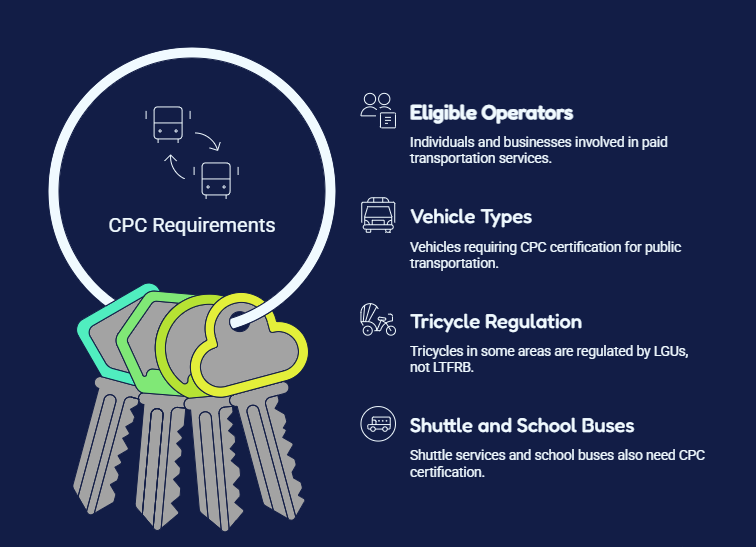
Any person or company that wants to transport passengers or cargo for a fee must get a CPC. This includes individual operators, corporations, cooperatives, and partnerships.
Vehicle Types That Require a CPC
The following vehicles need a CPC from LTFRB:
Grab, TNVS, Joyride, and Other Transport Network Operators
Grab, Joyride, Angkas, Move It, and Lalamove drivers or operators also need a CPC. However, the process is slightly different. TNVS applicants apply through the LTFRB online portal specifically for transport network companies. Note that Grab does not automatically provide a CPC for its drivers — each operator must apply individually.
Types of CPC Applications
New CPC Application
If you are applying for the first time, you need to file a new CPC application. This is the most detailed process and requires complete documents, financial proof, and route evaluation.
CPC Renewal
A CPC is valid for a limited period. When it expires, you must renew it before the deadline. Late renewals can lead to penalties or even cancellation of your franchise.
Amendment or Transfer
If you want to change your route, add more vehicles, or transfer the CPC to another person, you need to file an amendment or transfer application. This is also handled by LTFRB.
Provisional Authority (PA) vs CPC
A Provisional Authority (PA) is a temporary permit. It allows you to operate while your main CPC application is still being processed. PA is not permanent — you still need to complete the full CPC process. It is valid for a shorter period, usually up to one year.
Eligibility Requirements for CPC Application
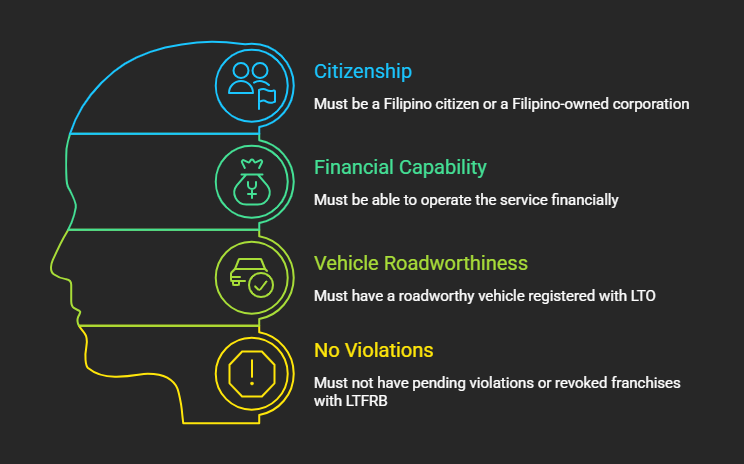
Before applying, make sure you meet these basic eligibility requirements:
LTFRB CPC Requirements and Documentary Requirements
Basic Documents
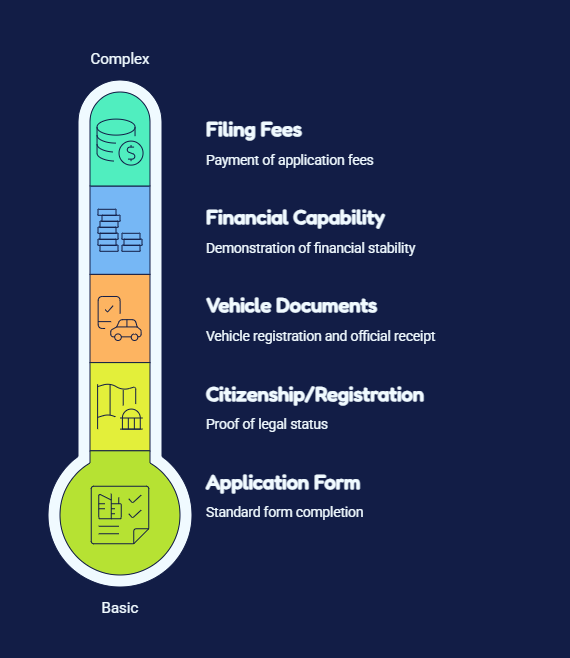
Here are the core documents you need to prepare for your CPC application:
Proof of Citizenship
You must prove your Philippine citizenship or the Filipino ownership of your company:
Proof of Financial Capability
LTFRB requires proof that you can financially sustain your transport operations:
Vehicle-Specific Documents
Different vehicles may require additional documents:
LTFRB Franchise Requirements for Vans and Other Public Utility Vehicles
Van operators (UV Express) must submit additional route and capacity documents. LTFRB will evaluate if there is a genuine need for the route you are applying for, based on Route Measured Capacity (RMC) data.
Additional Requirements for Business Entities
If you are applying as a corporation or cooperative, you also need:
How to Apply for a Certificate of Public Convenience (Step-by-Step)
Step 1 – Prepare the Required Documents
Gather all required documents before visiting LTFRB. Incomplete submissions are a common reason for delays. Double-check each document for completeness and notarization where required.
Step 2 – Complete the LTFRB Application Form
Download the official CPC application form from the LTFRB website (www.ltfrb.gov.ph) or get it directly from the LTFRB office. Fill it out completely and accurately. Any errors can delay your application.
Step 3 – Submit Your Application to LTFRB
Submit your application at the LTFRB Central Office in Quezon City or at the nearest LTFRB Regional Office. Make sure to get a receiving stamp and reference number for tracking.
Step 4 – Pay the Required CPC Fees
Pay the filing fee at the LTFRB cashier. Keep your official receipt — you will need it throughout the process. Fees vary depending on the vehicle type and number of units.
Step 5 – Technical and Financial Evaluation
LTFRB staff will review your documents and conduct a technical evaluation. This includes verifying your financial capability and checking if the route you applied for has capacity for more operators (based on RMC data).
Step 6 – Attend Hearings (If Required)
For new CPC applications, LTFRB may schedule a hearing. You or your authorized representative must attend. During the hearing, you may be asked to present additional documents or clarify your application.
Step 7 – Approval and Issuance of the Certificate of Public Convenience
Once approved, LTFRB will issue your CPC. Make sure to keep the original document safe. You must display the CPC or a copy inside your vehicle at all times while in operation.
Can You Apply for a CPC Online?
LTFRB Portal and TNVS Online Application Process
TNVS operators (Grab, Joyride, etc.) can apply through the LTFRB Online Application (FOA) Portal. Go to the official LTFRB website and look for the online application section for transport network companies. The portal allows you to submit documents digitally and track your application status.
How to Apply for Provisional Authority (PA) Online
Some PA applications can also be started online through the LTFRB portal. However, you may still need to visit the office for hearings or document submission depending on your vehicle type.
CPC Application Fees and Other Charges
CPC fees vary by vehicle type and number of units. Here is a general guide:
For taxis and TNVS, additional fees may apply. Always check the latest LTFRB fee schedule on their official website as fees are updated periodically.
Processing Time, Approval Timeline, and CPC Validity
Processing time varies depending on the type of application and the completeness of your documents. A typical new CPC application takes 3 to 6 months. Applications with complete documents and no issues are processed faster.
How Long Is a Certificate of Public Convenience Valid?
A CPC is usually valid for 5 years. After that, you must file for renewal before the expiration date. Operating with an expired CPC is treated the same as operating without one — it is illegal.
Download the Official LTFRB CPC Application Form
You can download the official CPC application form from the LTFRB website: www.ltfrb.gov.ph. Look for the “Downloads” or “Forms” section. You can also get a physical copy from any LTFRB office.
Policy Guidelines for Certificate of Public Convenience Issuance
Financial Capability Assessment
LTFRB checks if you have enough money to run your transport business. They look at your bank statements and financial records. This ensures you can pay for maintenance, fuel, and other operating costs.
Technical Evaluation
Your vehicle must pass technical inspection. It must be roadworthy, safe for passengers, and meet LTFRB standards. Vehicles that fail inspection will not be granted a CPC.
Route Measured Capacity (RMC)
LTFRB uses Route Measured Capacity (RMC) data to decide if a route needs more operators. If a route is already at full capacity, your application for that route may be denied. You may need to apply for a different route.
Rate and Fare Regulation
LTFRB also sets the fares you are allowed to charge. You cannot charge more than the approved rate. Fare changes require a separate process and LTFRB approval.
Provisional Authority (PA) in LTFRB
PA Meaning in LTFRB
PA stands for Provisional Authority. It is a temporary permit that allows you to operate while your main CPC application is still being processed by LTFRB. It is not a permanent franchise.
LTFRB PA Requirements
To get a PA, you generally need the same core documents as a CPC application:
How to Get Provisional Authority from LTFRB
File your PA application at the LTFRB office together with your main CPC application. LTFRB may grant PA while your main application is under review. Some PA applications can be started through the LTFRB online portal.
Can You Operate While Your CPC Application Is Pending?
Yes — but only if you have a Provisional Authority (PA). Without a PA, you cannot legally operate while waiting for your CPC. Operating without a PA or CPC makes your vehicle a colorum vehicle, which is illegal.
Common Reasons CPC Applications Are Delayed or Denied
Penalties for Operating Without a Valid CPC
Operating without a valid CPC means your vehicle is a colorum vehicle. This is illegal under Philippine law. Penalties include:
Colorum vehicles are regularly caught in LTFRB and MMDA operations. The risk is not worth it — always secure a valid CPC before operating.
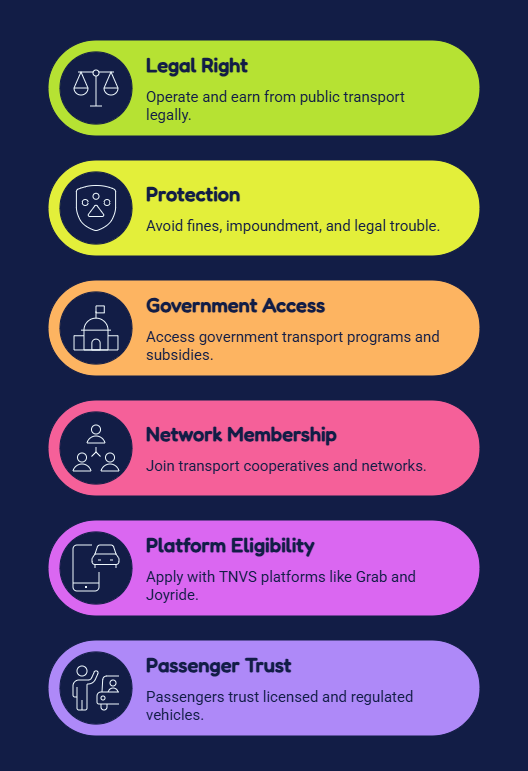
Benefits of Having a Valid Certificate of Public Convenience
Common Mistakes to Avoid During the CPC Application Process
Practical Tips Before Filing Your LTFRB CPC Application
Certificate of Public Convenience Sample and Application Form
CPC LTFRB Sample
A sample CPC from LTFRB shows the operator’s name, franchise number, approved route, vehicle details, and validity period. LTFRB does not officially publish sample CPCs online, but you can request to view one at the LTFRB office for reference.
Sample Certificate of Public Convenience
The format of a CPC includes a header from LTFRB, the franchise case number, operator details, vehicle description, approved route, and the signatures of authorizing officials. The document also includes the validity date.
Where to Get a Certificate of Public Convenience
A CPC is issued directly by LTFRB. You cannot buy it, transfer it informally, or get it from any other agency. It is issued only after a proper application process and evaluation.
Frequently Asked Questions
Final Thoughts
Getting a Certificate of Public Convenience (CPC) from LTFRB is not complicated if you prepare well. The key is to have complete documents, choose the right route, and follow the process step by step.
Whether you are a new operator or renewing your franchise, always deal directly with LTFRB. Avoid fixers and illegal shortcuts — they can put your franchise at risk.
If you found this guide helpful, share it with other transport operators who need help with their CPC application in 2026.